|
|
|
|||||||||
 |
||||||||||
 |
||||||||||
 |
||||||||||
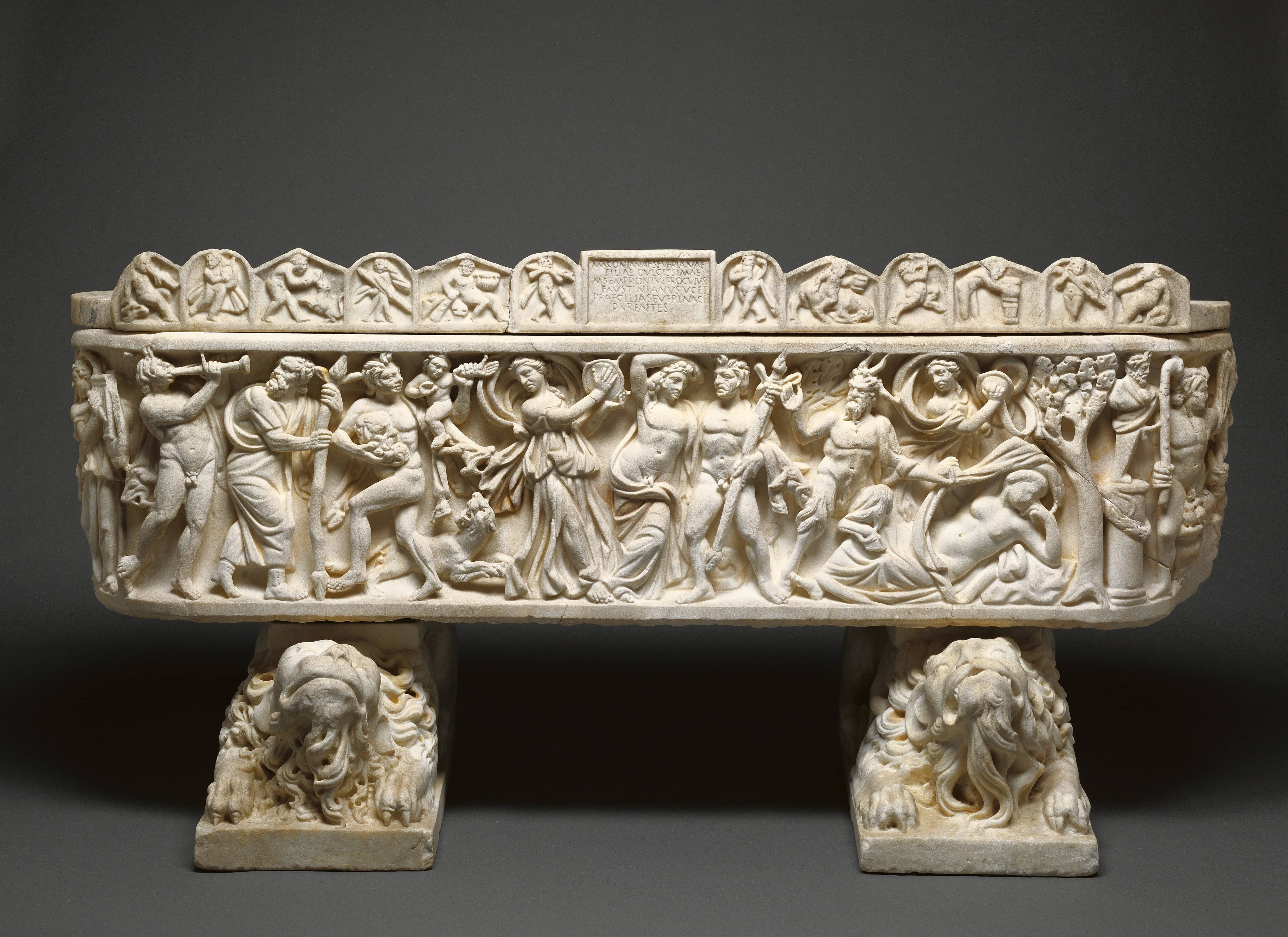
Roman sarcophagus of Maconiana Severiana Marble, anonymous (Roman), 210–220 J. Paul Getty Museum |
||||||||||
| In Roman society, elaborately carved stone sarcophagi became both fashionable and symbolic, signalling wealth, status, and cultural ambition. This intricately decorated sarcophagus was made for Maconiana Severiana, a young girl from a prominent Roman senatorial family. Its modest size suggests that she died at a young age. The inscription reads To Maconiana Severiana, most sweet daughter, Marcus Aurelius Proculus Faustinianus and Praecillia Severina, her parents. These sarcophagi were often pre-made with familiar mythological imagery and later customised with inscriptions and, sometimes, portraits of the deceased. Although Maconiana's name is preserved in the inscription, the face of the Ariadne figure, which was meant to represent her, was never carved. The front of the sarcophagus features a lively Dionysian scene. Satyrs, maenads, and a panther surround the intoxicated Dionysos as he draws near Ariadne, who lies asleep after being abandoned by Theseus. Pan lifts her veil, revealing her to Dionysos, symbolising a new life rather than an end. The back continues the Dionysian theme, depicting winemaking in a simpler, more stylised manner. Additional figures appear on either side of the inscription on the lid. For Romans, Dionysos was closely associated with the idea of renewal after death, which is why he frequently appears on funerary monuments, particularly those commemorating young individuals. The crouching lion supports, however, date from the 19th century. The sarcophagus was unearthed in Rome in 1873. |
||||||||||
 |
||||||||||