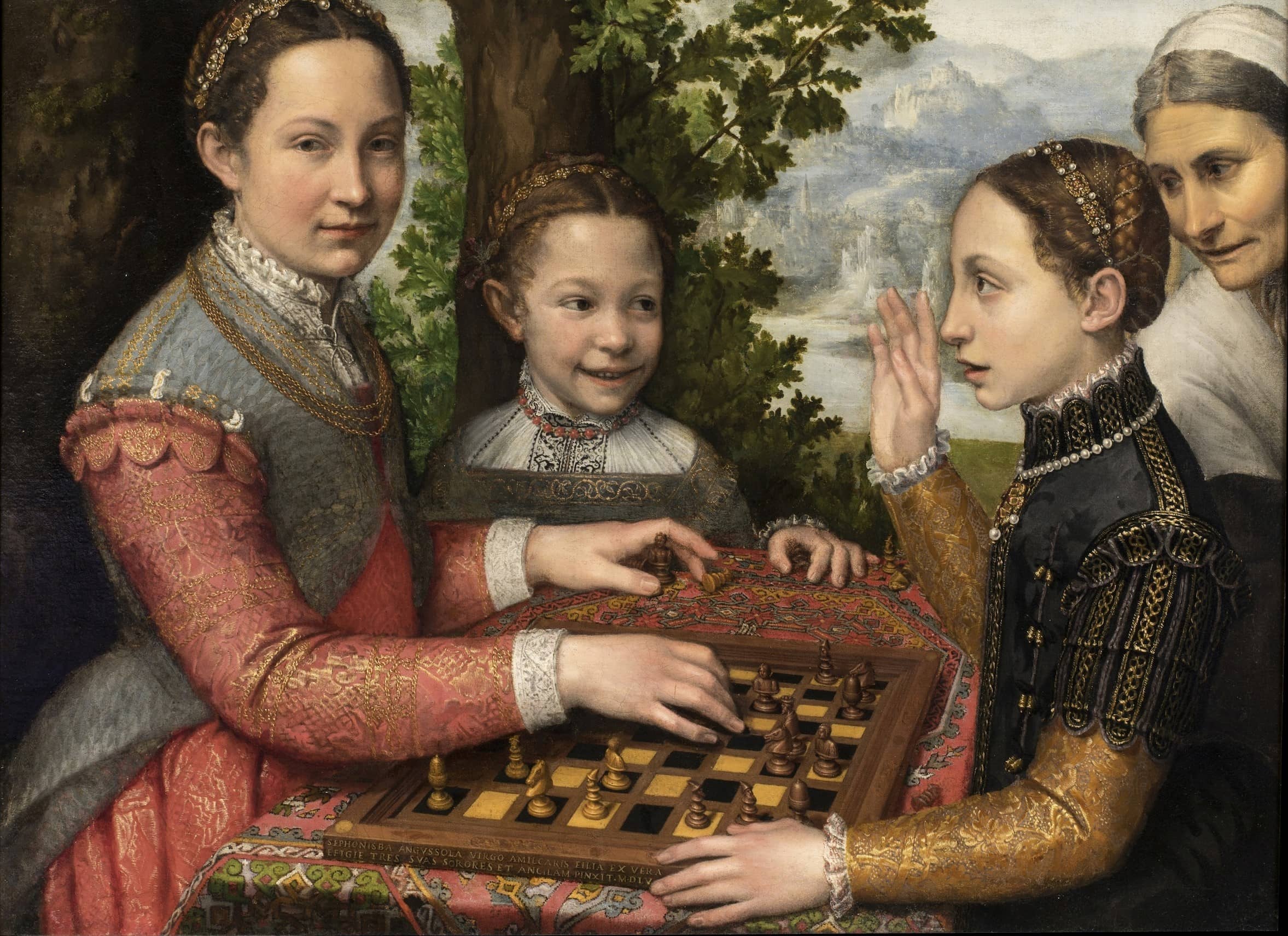
A rare and significant
example of early female portraiture by a woman artist, the painting
portrays Sofonisba’s three sisters—Lucia, Minerva, and Europa—engaged
in a game of chess, observed by a maid, likely their beloved nanny,
who appears in more than one of Anguissola’s works. What stands out
is not only the elegance and intimacy of the moment, but also the
confident display of the sisters' intellect, status, and refinement.
The lush textiles, detailed embroidery, and naturalistic expressions
reflect both Renaissance humanist ideals and the artist’s skill in
capturing personality. The backdrop lends the scene a feeling of
openness and balance, contrasting gently with the detail and
intimacy of the foreground: distant hills and a softly lit town and
castle are nestled amidst misty blue-grey terrain. Flanking the
scene are oak trees, which symbolise virtue, steadfastness,
strength, and endurance—qualities admired in aristocratic families.
They also symbolise ancestry and nobility. The Anguissola family was
noble, albeit impoverished, and through this painting Sofonisba was
making a case for her sisters’ and her own refinement. Positioned
behind the sisters, the oaks subtly frame the family and their
shared activity, grounding them in a context of enduring values and
quiet strength. They also draw a natural connection between the
inner world of the figures and the broader Renaissance ideals of
harmony between humanity and nature. The inscription on the
chessboard reads: 'Sofonisba Anguissola, the maiden daughter of
Amilcare, painted from life her three sisters and a maid, 1555.'
Technical imaging and layer analysis reveal that the composition was
revised: beneath the tree on the left, an earlier figure of a woman
in a bonnet was painted over. The present figure was added later
onto a finished landscape, suggesting Anguissola adjusted the scene
to refine its balance and interaction.