|
|
|
|||||||||
 |
||||||||||
 |
||||||||||
 |
||||||||||
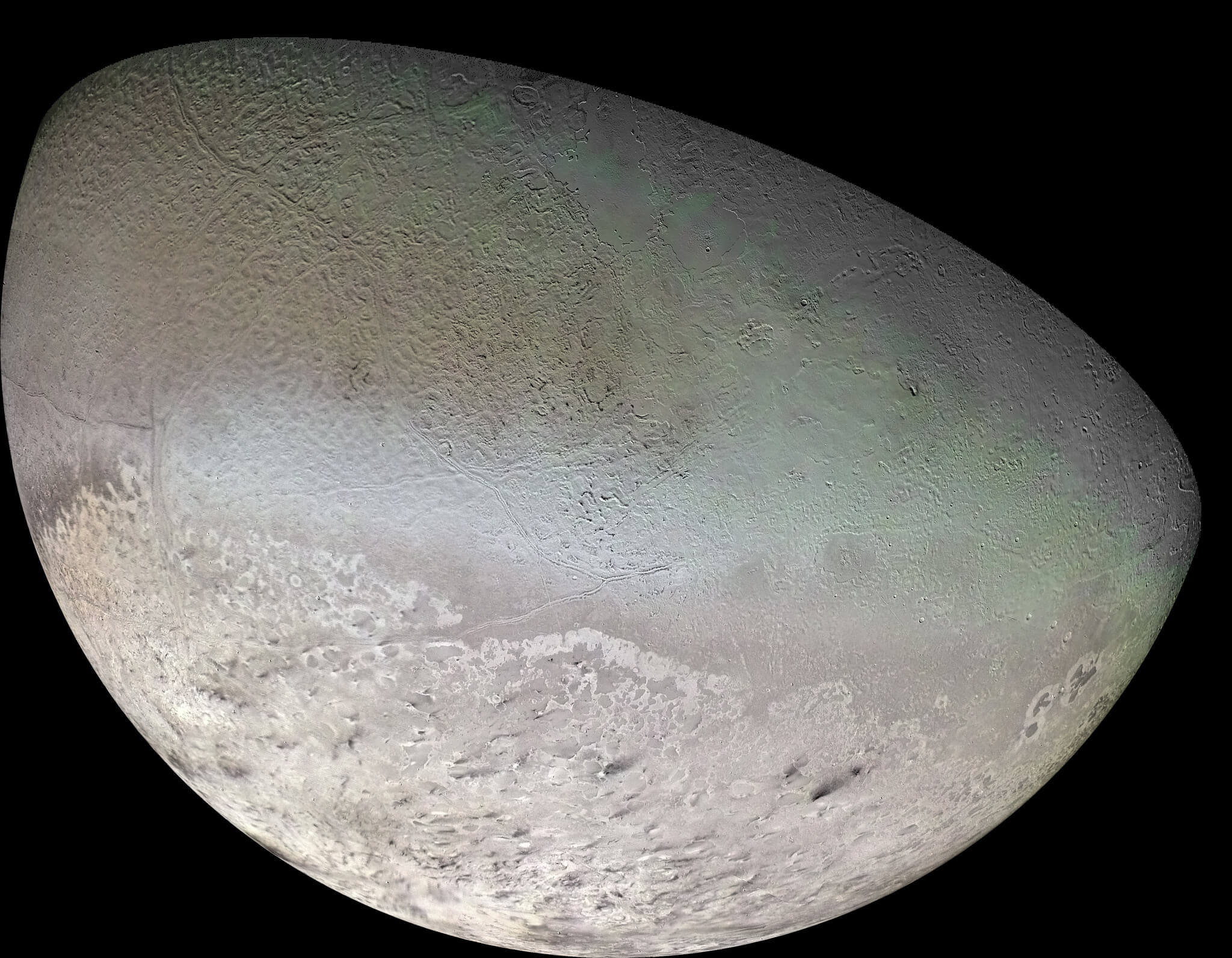
The moon Triton Global colour mosaic of Triton, taken by Voyager 2 in 1989 NASA |
||||||||||
| Triton, Neptune's largest moon, is a fascinating celestial body with unique characteristics. It is the seventh-largest moon in the Solar System and the only large moon in the Solar System that has a retrograde orbit, meaning it orbits Neptune in the opposite direction to the planet's rotation. It has a radius of 1,350 km (839 mi), about 22% smaller than Earth's Moon. Triton is believed to be a captured Kuiper Belt object due to its retrograde orbit and a composition similar to Pluto and other Kuiper Belt objects. It is also one of the coldest objects in the Solar System, with surface temperatures plummeting to minus 235 degrees Celsius (-391 degrees Fahrenheit). Triton is geologically active, featuring cryovolcanism and intriguing surface features such as cantaloupe terrain and vast plains of nitrogen ice. Its thin atmosphere primarily consists of nitrogen with trace amounts of methane, and it is continually replenished by the sublimation of surface ice. Triton's complex and dynamic nature makes it a subject of intense scientific interest and a key target for future exploration missions. |
||||||||||
 |
||||||||||