

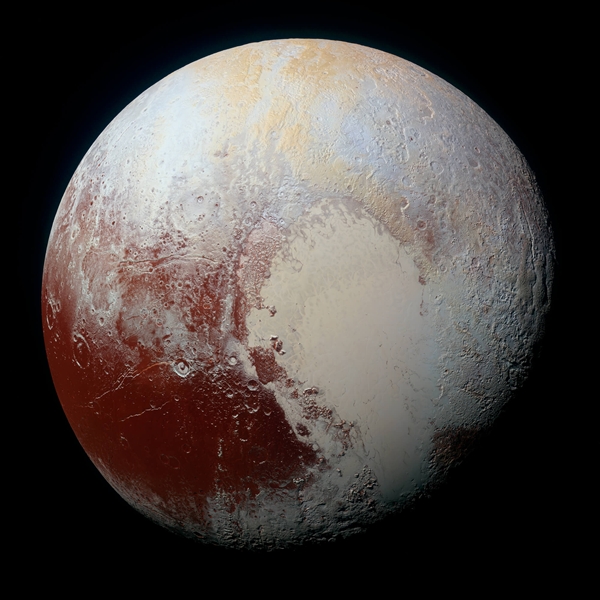
Pluto
Taken by NASA’s
New Horizons spacecraft, 2015
NASA / JHUAPL / SwRI
The image was in enhanced colour, to illustrate differences in the
composition and texture of Pluto’s surface
Pluto, once considered the ninth planet in our solar system, was
reclassified as a dwarf planet by the International Astronomical
Union (IAU) in 2006. Located in the distant regions of the Kuiper
Belt, a vast area beyond Neptune, Pluto has a unique and eccentric
orbit that takes it closer to the Sun at times. With a diameter of
about 1,473 miles (2,377 kilometres), Pluto is significantly smaller
than the Earth's moon. Its surface is composed of a mixture of
nitrogen, methane, and carbon monoxide ices, giving it a distinctive
reddish-brown colour. Pluto has a single large moon, Charon, which
is unusually large compared to its parent dwarf planet. Despite its
small size and remote location, Pluto has captured the curiosity of
scientists and the public alike, leading to various space missions
aimed at studying this enigmatic world, such as NASA's New Horizons
mission, which provided valuable data and images during its historic
flyby in 2015.


