
|
|
|
|||||||||
 |
||||||||||
| Caspar David Friedrich (1774–1840) | ||||||||||
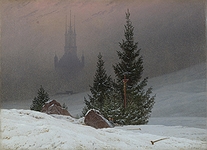
| Friedrich was a German Romantic landscape painter, widely considered the most significant and influential artist of his generation in Germany. Born in Greifswald, he studied at the Academy of Copenhagen under Christoffer Wilhelm Eckersberg, where he developed a new appreciation for the complexity and emotional influence of nature, beginning to see moods and humours as romantic as they were modern. He also developed a deep interest in 17th-century Dutch landscape painting. In 1798, he settled in Dresden and later travelled to Rügen, the Giant and the Harz Mountains, and Italy. Friedrich matured his signature style, characterised by large-scale, highly detailed landscapes imbued with symbolism. His painted works often depict solitary figures dwarfed by majestic mountains, vast seascapes, or ancient ruins—all bathed in dramatic lighting and shrouded in mist. He also etched several plates of landscapes and trees. Rather than capturing specific locations, Friedrich sought to evoke awe and contemplation in the viewer. His work reflected the burgeoning Romantic movement’s emphasis on spirituality and the sublimity of nature—a stark contrast to the prevailing Enlightenment ideals of reason and order. In 1817, he became a professor at the Academy of Dresden, and in 1840, a member of the Academy of Berlin. In later life, he faced criticism for his perceived conservatism, and his work was not fully appreciated until it was shown in the German Centenary Exhibition of 1906, where he was ultimately recognised as a foundational figure in the history of art. He died in Dresden. | ||||||||||
| |
||||||||||


 |
||||||||||
|
|
||||||||||
| |
||||||||||
  |
||||||||||


 Art
Art