|
|
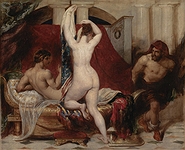
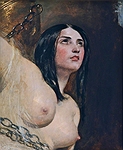
William Etty (1787–1849) A British painter born at York, Etty, after some scanty instruction of the most elementary kind, became a bound apprentice in the printing-office of the Hull Packet at the age of eleven. After seven years, he moved to London. With the help of an uncle, he commenced his artistic education; in 1807, he enrolled as a student of the Academy, some of his fellow scholars being Wilkie, Haydon, Collins, and Constable. That year, he was admitted to be a private pupil of Sir Thomas Lawrence, who influenced his work for some years. After many failures, his Coral-finders, exhibited at the Royal Academy in 1820, attracted much attention, and he began to enjoy increasing success. He travelled to Paris, Rome, and Venice in 1822 to study the old masters, and elicited many expressions of wonder. His own style as a colourist held much more of the Venetian than of any other Italian school, and he admired his prototypes with a zeal and exclusiveness that sometimes bordered on extravagance. Returning home in 1824, he was made an associate of the Royal Academy, and in 1828, he was promoted to the full dignity of an Academician. During the next ten years of his life the zeal and unabated assiduity of his studies continued, and he was a constant attendant at the Academy Life School, where he used to work regularly along with the students. He retired to York in 1848, and in 1849, a large exhibition of his works was held in London. Etty holds a secure place among English artists. His drawing was frequently incorrect, but in feeling and skill as a colourist he has few equals. His most conspicuous defects as a painter were the result of insufficient general culture and narrowness of sympathy. |
|
||||||
|