|
|
|
|||||||||
 |
||||||||||
| French Watercolours | ||||||||||
|
There are in France to-day three distinct classes of cities—one
might even add, of cathedral cities—and as the bishopric is a
dignity far more usual in France than in England, 'cathedral' may serve
for the present as a term inclusive of many towns. Firstly, there is
the town whose local importance has remained unchanged through a succession
of centuries and an eventful history, which has added a modern importance
to that bequeathed to it by Time. Such towns are Le Mans, Angers, Amiens,
and Rouen. Secondly, we find the towns whose glory has departed, but
who still preserve the outward semblance of that glory, though they
remind us in passing through them of a body without a spirit, of an
empty house, whose inhabitants are long dead and have left behind them
only the echoes of their past footsteps. These towns are a picturesque
group, and if we go back upon the centuries, we shall find in them the
centre of much that has made history for our modern eyes to read. Look
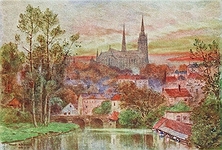
at Chartres and Bayeux, and Lâon and Troyes, for embodiments of this
type. And lastly, there are the cities which exactly reverse the foregoing
state of affairs, and owe their growth to the kindly fostering of a
later age—an age which has learnt wisdom more quickly than its
predecessors, and has learnt, moreover, to love the whirr of engines
and the busy paths of commerce more than the safe keeping of ancient
monuments and the reading of history in the worn greyness of their stones. — Herbert Marshall and Hester Marshall, 1907 |
||||||||||
. |
||||||||||
| |
||||||||||
| |
||||||||||
 |
||||||||||