|
|
|
|||||||||
 |
||||||||||
 |
||||||||||
 |
||||||||||
Adriaan
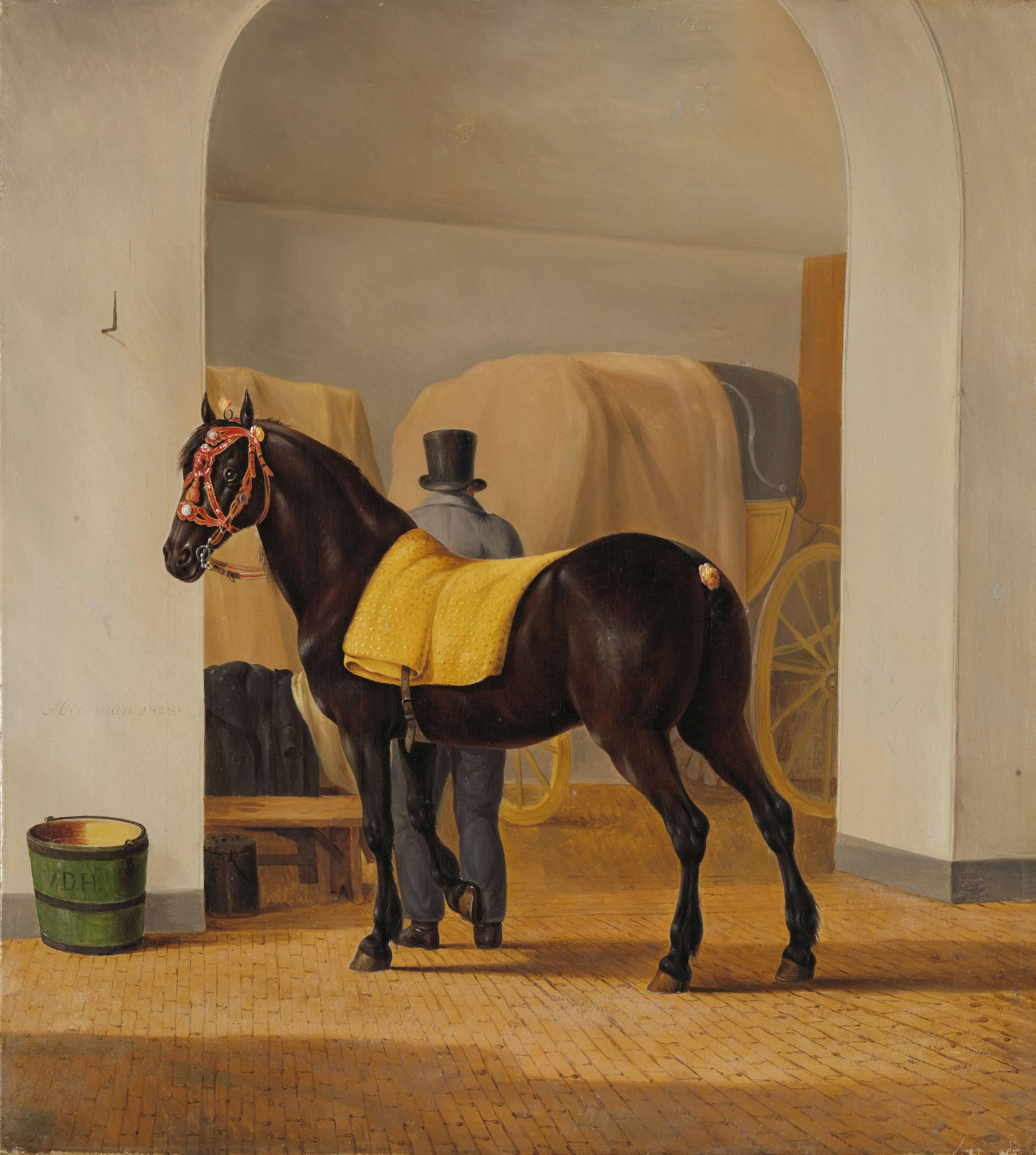
van der Hoop's Trotter 'De Rot' at the Coach House Oil on canvas, 61 x 54.5 cm, by Anthony Oberman, 1828 Rijksmuseum, Amsterdam |
||||||||||
| The prize-winning racehorse 'De Rot' wears a decorated bridle, and its tail is tied up and embellished with a rosette in the latest fashion à l’anglaise. A man stands by in the coach house, where there are no fewer than two carriages, one in fashionable yellow, matching the horse blanket on the animal’s back. The painting is signed by Oberman on the walls, and below it, the initials of its owner, Van der Hoop, are on the green bucket. One of the most interesting features of the painting is the way the horse is positioned. Its body is turned slightly away from the viewer, but its head is turned back, almost as if acknowledging our presence. This creates a sense of alertness and personality, emphasising the horse as more than just an object—it has character, a life of its own. The bridle, with its red and gold details, suggests the horse is of high quality, likely a prized trotter used for elegant carriage rides rather than rough labour. The yellow saddle cloth, an unusual choice, adds a regal touch and contrasts beautifully against the dark brown coat. The setting is just as important. The arched doorway frames the horse perfectly, giving it a sense of prominence. Beyond the arch, the covered carriage hints at a world of aristocratic travel, but interestingly, it is partially obscured. This shifts the focus onto the horse rather than the vehicle, reinforcing the idea that the animal itself is the true subject of admiration. The brick floor, polished and warm in colour, reflects the light softly, adding depth and atmosphere. The man in the background is turned away, not interacting with the viewer or the horse, and is secondary in the composition, subtly underscoring the hierarchy of importance—first, the horse, then the person. |
||||||||||
 |
||||||||||