
|
|
 |
|
||||||||
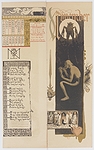
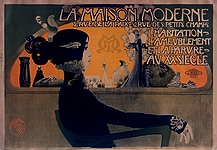
Manuel Orazi (1860–1934) |
||||||||||
Born Emmanuel Joseph Raphaël
Orazi in Rome, Manuel Orazi was an Italian-French artist whose work
became closely associated with the stylistic principles of the Art
Nouveau movement.Trained at the esteemed Ricordi printing house, his
early exposure to the world of graphic design and printmaking laid the
groundwork for a career marked by stylistic refinement and technical
sophistication. Relocating to Paris in 1892—then the epicentre of
progressive artistic activity—Orazi integrated swiftly into its rich
artistic circles and developed professional ties with leading figures
such as Alphonse Mucha and Eugène Grasset. Orazi’s artistic output,
which spanned painting, illustration, jewellery, and poster design,
consistently reflected the elegance, fluidity, and organic symmetry
characteristic of Art Nouveau. His work frequently drew upon floral and
geometric forms and bore the unmistakable imprint of Japanese visual
culture, particularly in its compositional restraint and decorative
clarity. His 1900 poster for the Exposition Universelle in Paris remains
one of his most celebrated achievements, emblematic of his mastery of
lithographic technique and the aesthetic ethos of his time. Alongside
his contributions to poster art, his jewellery designs—often produced
for Maison Moderne—demonstrated his ability to adapt decorative ideals
into wearable forms of art. In the later stages of his career, Orazi
turned to cinema, notably designing sets for the 1921 silent film
L’Atlantide, thereby extending his creative influence into emerging
visual media. Throughout his life, he remained committed to the ideals
of Art Nouveau, producing work that embodied the movement’s dedication
to artistic unity, natural beauty, and innovation. Orazi died in Paris. |
||||||||||
| |
||||||||||
 |
||||||||||
  |
||||||||||


 Art
Art