|
|
|
|||||||||
 |
||||||||||
 |
||||||||||
 |
||||||||||
Mechanical
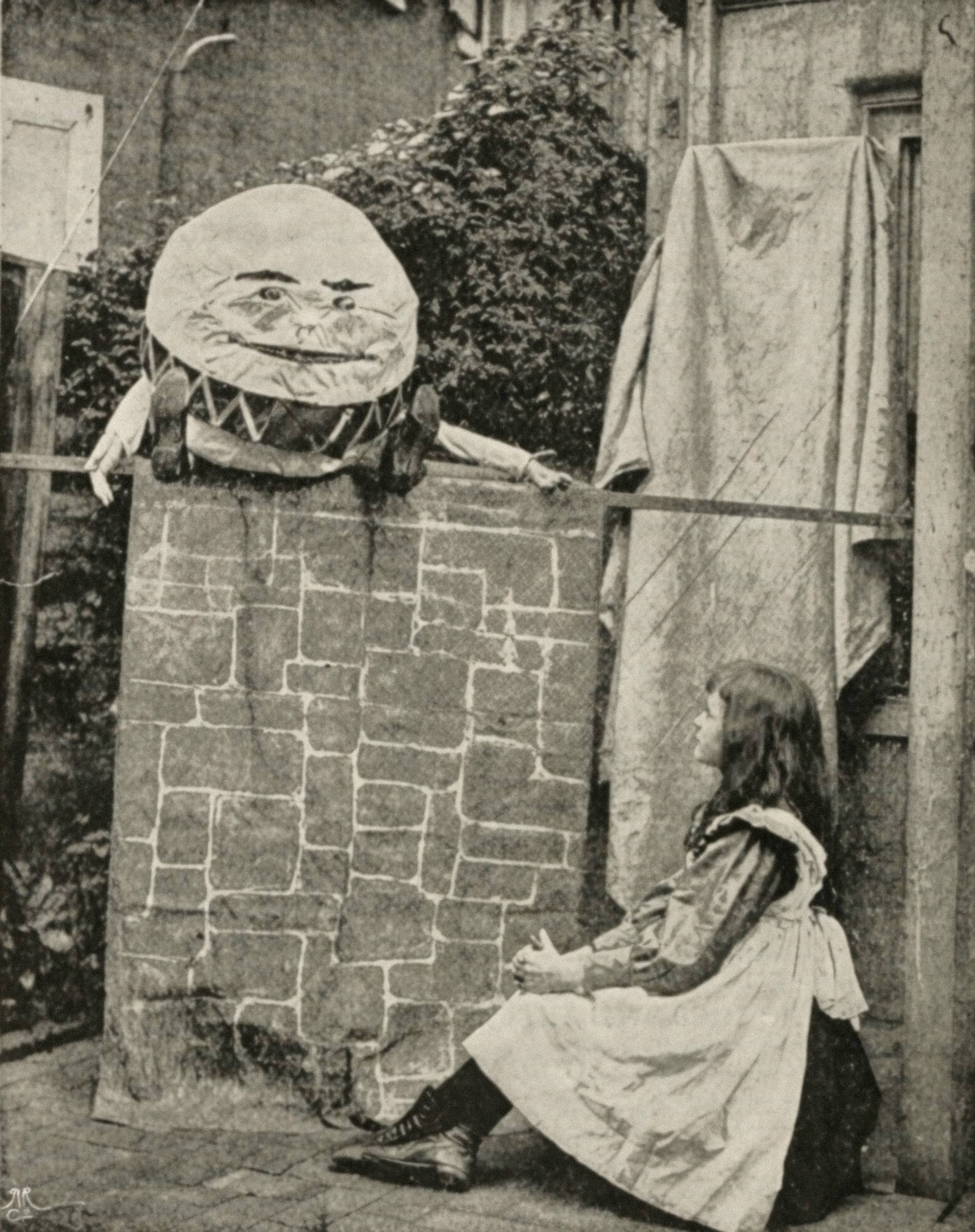
Humpy Dumpty Albumen print, by Charles Lutwidge Dodgson (Lewis Carroll), c. 1870 |
||||||||||
| Walter Lindsay constructed this small theatrical automaton of Humpty Dumpty to perform the Humpty Dumpty scene from Through the Looking-Glass. Lindsay explained that he got the idea from an article in Cosmopolitan magazine around 1891 that described something similar, though more basic, and he modelled his version on the illustration by John Tenniel. His Humpty was about 76 centimetres high, with a white face, and dressed in brilliant blue. He wore grey stockings and an orange cravat with a zigzag pattern in blue. He sat on a miniature stage with a curtain. Humpty was constructed from barrel hoops covered with stiff paper and muslin, with rag-stuffed muslin eyes mounted on pivots and connected by tapes to a row of levers that moved them in different directions, while the worsted-and-indiarubber eyebrows, the arms, and the mouth were likewise operated by threads, tapes, and pedals within the figure. A spring clothes-pin in the right hand enabled him to hold Alice’s notebook. The performer stood behind the wall with his head inside the egg, which was open up the back, operating a keyboard-like row of levers that controlled the expressions and gestures, including the red-tape smile drawn out through slits at the corners of the mouth. When Humpty was about to perform, a brief address was usually given before the curtain rose, explaining the shop scene from Through the Looking-Glass in which the Sheep is knitting and then places an egg on a shelf, and as Alice walks towards it the shop magically dissolves and the objects around her transform into the landscape of a wood. The egg grows larger and more human-like as she approaches, eventually becoming Humpty Dumpty. At this point during the performance the curtain rose and the audience was presented with the mechanical Humpty sitting on the wall. As soon as the audience had composed themselves, Alice entered and the conversation continued just as it was in the book. Humpty gesticulated with his arms, rolled his eyes, raised his eyebrows, frowned, turned up his nose in scorn at Alice’s ignorance, and smiled when he shook hands with her. Besides this, his mouth kept time with his words throughout the dialogue. Because the audience laughed so loudly at Humpty's facial expressions that they drowned what he was trying to say, sentences often had to be repeated. Humpty proved very popular, and as the number of performances grew he was eventually retired when the performers could no longer meet the demand. Having travelled to many places during his career, he had already begun to lose his shape by the time he sat for this portrait. |
||||||||||
 |
||||||||||