
|
|
|
|||||||||
 |
||||||||||
| Suzuki Harunobu (1725?–1770) | ||||||||||
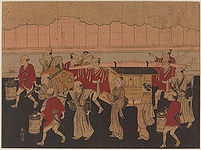
| An Edo (now Tokyo) native, Suzuki was a pioneering Japanese ukiyo-e artist who transformed woodblock printing. In 1765, he introduced nishiki-e (full-colour prints), which replaced earlier methods that used only two or three colours. His name became synonymous with 'nishiki-e' or 'brocade prints', earning him recognition as the originator of Japanese polychrome printing. Although he is thought to have studied under Nishikawa Sukenobu in Kyoto, his early work received little attention until he developed the multicolour technique. Specialising in bijinga (prints of beautiful women), Suzuki depicted women from all levels of society—from courtesans in the pleasure quarters to middle-class women engaged in everyday tasks, as well as mythological figures. His skill in the use of colour and the graceful backgrounds he created added depth and mood to his compositions. In contrast to the shunga genre, known for its erotic themes, his work focused on romanticism and beauty, conveyed through soft colours and graceful lines. Suzuki idealised representations of love were widely admired by his contemporaries, setting a new standard that influenced successive generations of Japanese printmakers. He died in Edo. | ||||||||||
| |
||||||||||

 |
||||||||||
|
|
||||||||||
| |
||||||||||
  |
||||||||||


 Art
Art