|


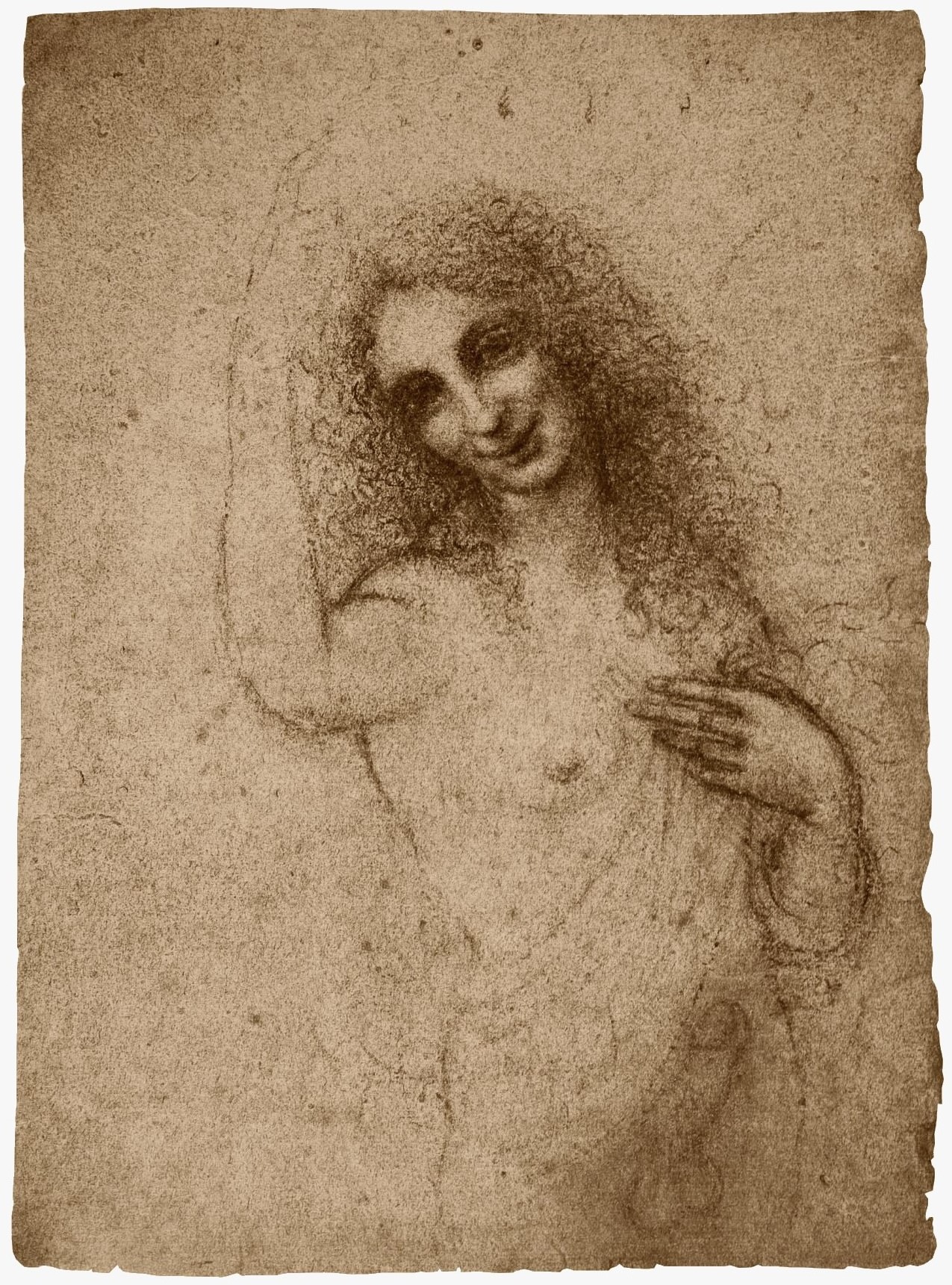
The Incarnate Angel
Charcoal on blue paper, attributed to Leonardo da Vinci (or the school
of), 1513–14
Private collection, Germany
Discovered in 1991, this drawing has become quite controversial due to
the figure's ambiguity. It depicts an androgynous being with long,
flowing hair and a pose that's both graceful and suggestive. The title
indicates a religious figure, but the lack of wings and the figure's
exposed breast and genitals challenge that notion. This explicit detail
has led some to believe that it is not an angel at all, but rather a
study of a young model–it has been suggested that it is an androgynous
depiction of Salai, da Vinci's young student, because his name
appears on the reverse, but is crossed out–possibly even a veiled
self-portrait of da Vinci in his youth. However, others argue it could
be a representation of a specific type of angel or a commentary on human
duality. Some scholars have linked this portrait to da Vinci's later
painting of Saint John the Baptist, noting similarities in the
pose and overall physicality of the figures. This has generated the
additional theory that the drawing is a humorous take on that painting.
In any case, the work is a masterclass in da Vinci's signature sfumato.
It appears that an attempt had been made to censor the figure's lack of modesty,
but this has been debated as it may have been carried out by da Vinci
himself, or the result of damage, or later modifications. Owned by Queen Victoria as part
of the Royal collection, the drawing was sold to a German collector, who
is believed to be the current owner.

|
|
|