|


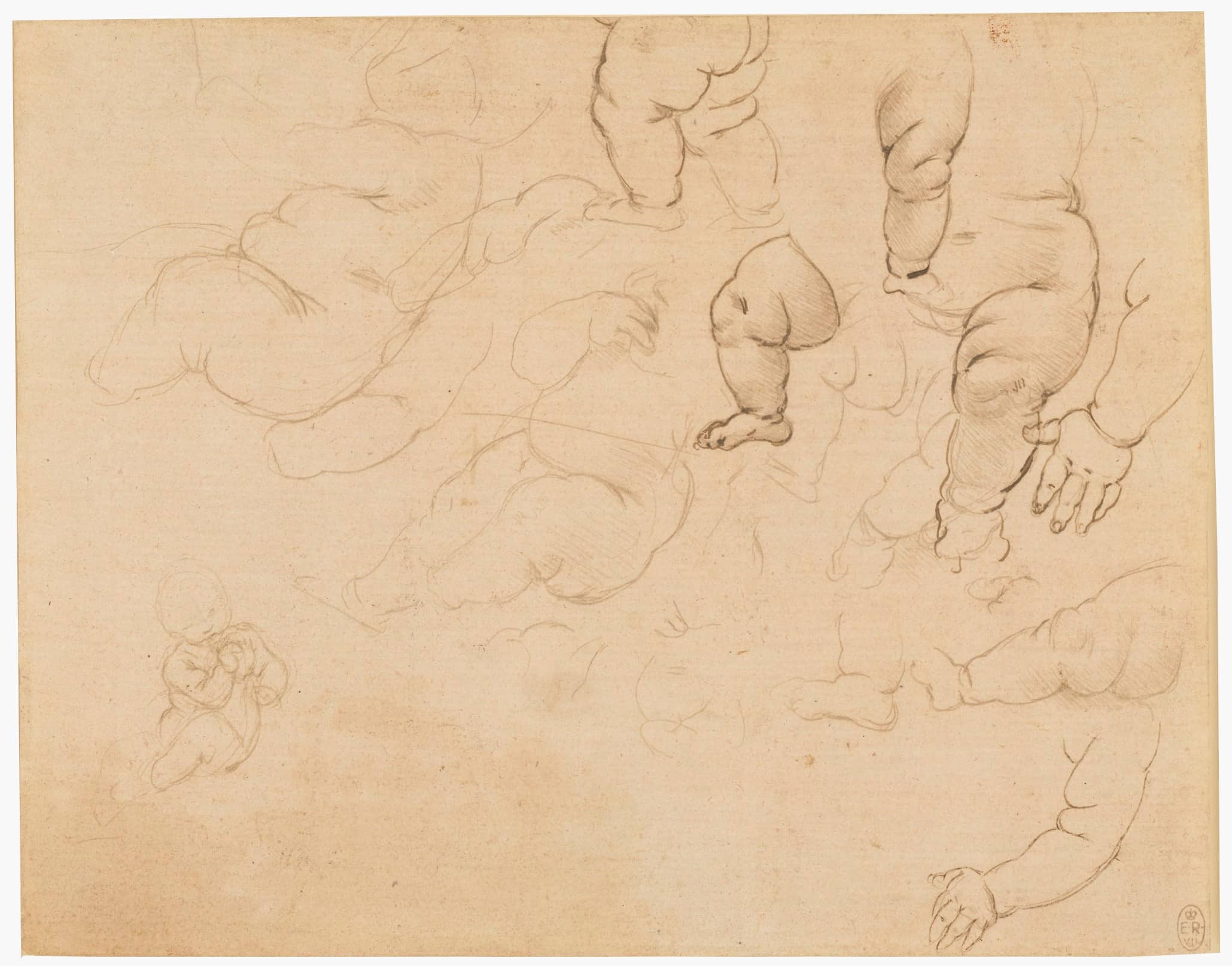
Studies
of an infant
Metalpoint, pen and ink on paper, 17.1 x 21.8 cm, by Leonardo da Vinci,
c. 1490–92
Royal Collection Trust, London
This drawing, likely created during his time in Milan in the late 1480s,
features a collection of detailed studies focused on a naked baby, particularly
its legs. The drawing, executed with faint metalpoint lines on a pale
pink background, displays the baby in various poses: one sucking its
fingers, another raising a hand in blessing. This sheet exemplifies
da Vinci's dedication to life drawing as a method for artistic exploration
and development. While some of the studies might have connections to
his Madonna and Child compositions, as shown in the depiction
of a healthy, chubby baby, a common motif in 15th-century Italian paintings,
the drawing primarily served as a tool for capturing natural forms and
experimenting with ideas. This is evident in how da Vinci filled the
page with spontaneous sketches, focusing on individual limbs and capturing
the baby's natural movements. The emphasis on life drawing reflected
a broader artistic trend during the Renaissance, fuelled by the increased
availability of paper due to the boom in book printing. This shift allowed
artists like da Vinci to move away from the traditional focus on craftsmanlike
execution and explore their own artistic vision. Interestingly, the
confident lines employed in the drawing suggest a later date than initially
thought, possibly just before da Vinci abandoned metalpoint altogether
in the early 1490s. Additionally, while some of the limb details closely
resemble those of the Christ Child in da Vinci's Benois Madonna,
a painting likely executed years before this drawing, it highlights
his tendency to revisit and adapt motifs throughout his career, even
across decades.
|
|
|
Provenance
 Francesco
Melzi Francesco
Melzi
Pompeo
Leoni, c. 1582-90
Thomas
Howard, 14th Earl of Arundel, by 1630
Probably
Charles II, King of Great Britain
Royal
Collection, by 1690
Source: The Royal Collection, 2023.
|