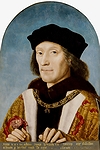
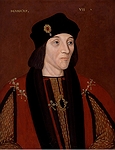
Henry
VII
King of England
(1457–1509)
Biographical
King of England 1485–1509
2nd Earl of Richmond 1457–62, depr.
The first monarch of the Tudor dynasty, Henry rose to power after defeating
Richard III at the Battle of Bosworth on 22 August 1485, which effectively
ended the Wars of the Roses. Born at Pembroke Castle in January 1457
to Edmund Tudor and Margaret Beaufort (who was descended from John of
Gaunt, and through her, Henry claimed the English throne), he became
fatherless shortly after birth, and was brought up under constant threat
after Edward IV’s victory. His early years were marked by imprisonment
and refuge in Brittany, where his uncle, Jasper Tudor, took him to safety.
After the defeat of his rival Richard III, Henry's first act as king
was to secure his throne through marriage to Elizabeth of York, daughter
of Edward IV, thereby uniting the warring factions of Lancaster and
York. This union helped legitimise his claim and diminished the possibility
of further civil conflict, though his reign was still troubled by Yorkist
pretenders. The most notable of these was Lambert Simnel, who was crowned
as Edward VI in Ireland in 1487 but was quickly defeated at the Battle
of Stoke. Another, Perkin Warbeck, claimed to be the surviving Richard,
Duke of York, and garnered foreign support from France, Burgundy, and
Scotland. Warbeck’s rebellion also failed after multiple failed
invasions and was finally quashed in 1497, though he was not executed
until later for attempting another escape from the Tower of London.
Henry's reign was largely focused on consolidating power, strengthening
the monarchy, and securing England's financial stability. He avoided
major foreign conflicts, though he did engage in a brief war with France
in 1492, largely driven by his desire for an alliance with Spain and
the security of Brittany. This resulted in the Treaty of Etaples, which
ended the war and secured a French payment to England. He also focused
on enhancing his wealth and ensuring the financial security of his reign,
often resorting to heavy taxation and the actions of his agents, Empson
and Dudley, to extract funds from the nobility, which led to his unpopularity
in later years. Despite this, Henry accumulated great wealth, becoming
one of the richest monarchs in Europe, and used this to further his
ambitions, such as supporting infrastructure projects like the chapel
at Westminster and the hospital of the Savoy. He also laid the foundation
for his son Henry VIII’s foreign policy and secured England’s
relative peace and prosperity, thanks to his diplomacy and careful economic
management. His reign saw the expansion of trade, the strengthening
of the navy, and the establishment of a naval dock at Portsmouth, which
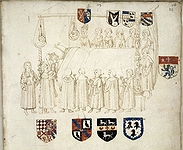
would prove instrumental in the future. Henry VII died in April 1509,
leaving behind a more stable and prosperous kingdom, having succeeded
in ending the Wars of the Roses, centralising royal power, and securing
the Tudor dynasty.
Place of birth: Pembroke Castle, Wales
Place of marriage: Westminster Abbey
Place of death: Richmond Palace, Surrey
Place of burial: Westminster Abbey
Son of Edmund Tudor and Margaret Beaufort, he married Princes Elizabeth
of England (York) in 1486, and had issue.
|