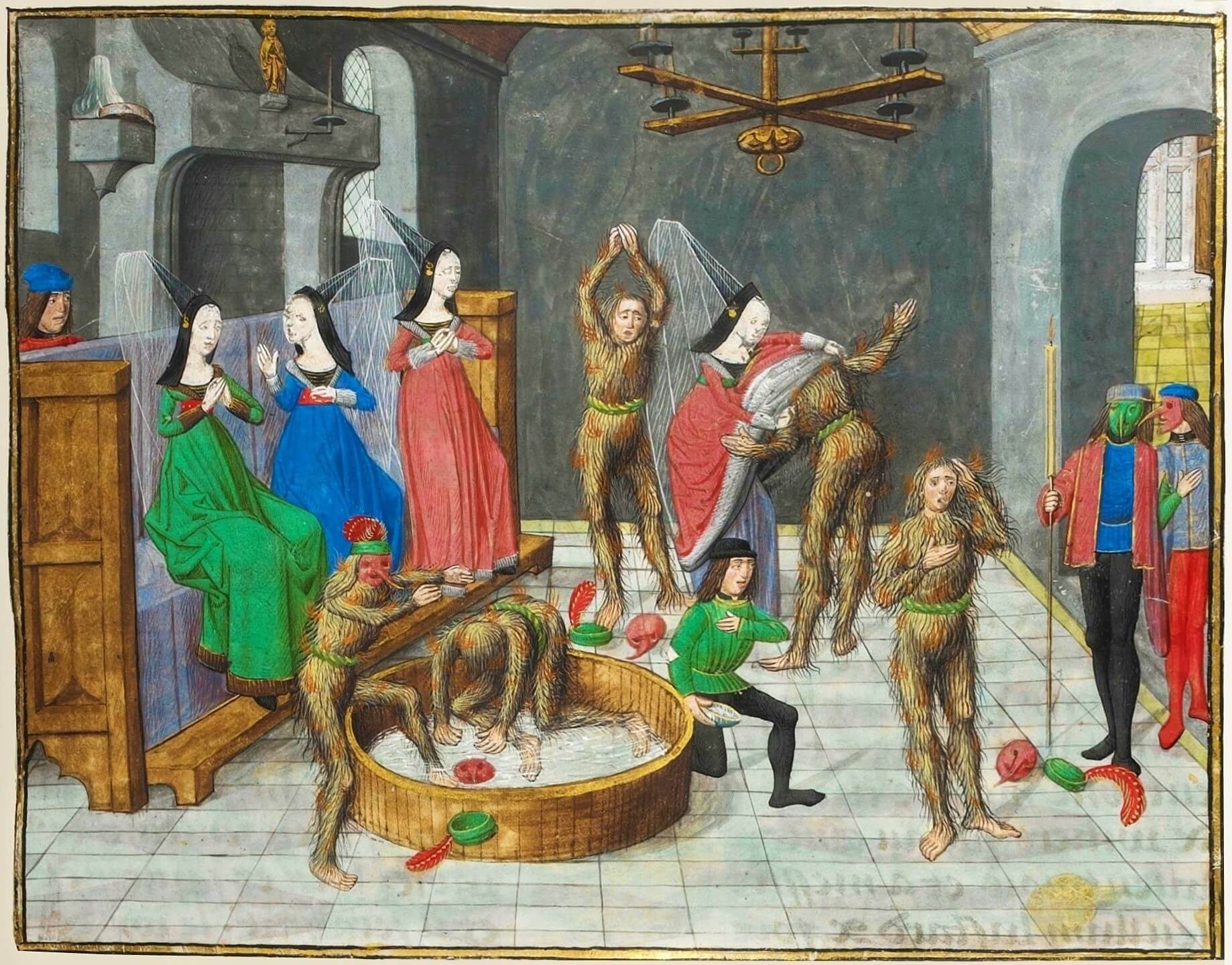
Masque of King Charles VI of France (Bal des Ardents)
From the Royal 18 E II manuscript, by Jehan Froissart, , before
1483, British Museum
In 1393, the queen married one of her ladies of honour, who was
a widow. In that age it was customary to celebrate the marriage
of widows with the most riotous and extravagant mirth; every one
who was present at the festivities was allowed to do or say what
he liked with the most unbounded freedom; and the weak king and
his bad favourites determined to make this an occasion for exceeding
even the licentiousness usual on such occasions. One of the king's
favourite counsellors in his pleasures, a wicked man named Huguet
de Guisay, contrived a new mode of putting in effect their design;
at his suggestion the king and five of his knights (Huguet de Guisay
being himself one), equipped themselves as satyrs, sewn up
in vests of linen which fitted tightly the whole of their bodies,
and which was covered externally with a coating of rosin and pitch
(resin), on which flax tow was attached so as to make them look
hairy like goats. On their heads they placed hideous masks.
When the ladies of the court, and the new married pair, with their
friends, were celebrating their nuptials in the royal palace of
St Paul, in the night of the 29th of January in the year above mentioned,
the king and his five knights, thus disguised, rushed into the hall,
howling like wolves, dancing and leaping about in the most extravagant
style, and exhibiting a thousand uncouth and unbecoming gestures.
In the midst of the confusion which they thus created, the Duke
of Orleans (the king's brother) and the Comte de Bar, who had been
passing the evening elsewhere, arrived, and, thinking to heighten
the merriment and frighten the ladies, they set fire to the hairy
covering of some of the masquers. The pitch and rosin immediately
caught the flame, and the satyrs became in a few seconds so many
blazing fires. As the dresses had been sewn close to their bodies,
it was impossible to deliver themselves from them, and the five
knights, like living masses of fire, threw off their masks, and
ran from one side of the hall to the other, in the most excruciating
torments, and uttering the most terrible cries.
At the moment when this disaster took place, it happened that the
king was apart from his companions, running after the young duchess
of Berry; who, when she saw what had happened, held him fast and
covered him with her robe, so that no spark could fall upon
him, and he was thus saved. The queen and most of the other ladies
fled in the utmost terror to a more distant part of the house. One
of the knights with more presence of mind than his companions, rushed
into the kitchen and threw himself into a large tub full of water,
and thus saved himself. The other knights burnt during about half
an hour; one of them died on the spot; two died on the second day;
and Huguet de Guisay, the contriver of this unfortunate masque,
outlived it three days in extreme torments. The king, though he
escaped the fate of his fellow masquers, was thrown by the fright
into a long fit of madness.
Huguet de Guisay was a proud overbearing man, cruel and tyrannical
in the extreme, and on that account an object of general detestation:
he was in the habit of treating the poor commoners, and his own
servants, in the most brutal manner, beating them like dogs, throwing
them down and kicking them with his spurs, and forcing them to bark.
His death created a general feeling of joy, and as his funeral procession
passed the street, the populace saluted the body with the words
he had so often used to others, 'bark, dog!'


