


Amazon
Ads |



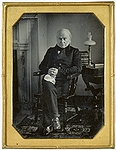
John
Quincy Adams
6th President of the United States of America
(1767–1848)
Biographical
President of the United States of America
1825–29
Member of the House of Representatives
1831–48†
US Secretary of State 1817
Minister to Great Britain 1815–17
Minister to Russia 1809–15
A peace commissioner negotiating end to War of 1812 with Great Britain
1814
US Senator for Massachusetts 1803–08
Boylston Professor of Rhetoric and Oratory Harvard 1805
Member of the Massachusetts Senate 1802–03
Minister to Prussia 1797–1801
Minister to Portugal 1797–98
Minister to the Netherlands 1794–96
Secretary and interpreter to Francis Dana, American representative at
St Petersburg, Russia 1781–83
The eldest son of President Adams, the sixth President of the United States,
John Quincy Adams was born in that part of Braintree that is now Quincy,
Massachusetts, and was named after John Quincy, his mother’s grandfather,
who was for many years a prominent member of the Massachusetts legislature.
In 1778, and again in 1780, young Adams accompanied his father to Europe;
studying in Paris in 1778–79 and at the University of Leiden in
1780. In 1780, he also began to keep that diary which forms so conspicuous
a record of the doings of himself and his contemporaries. In 1781, at
the age of fourteen, he accompanied Francis Dana, American envoy to Russia,
as his private secretary; but Dana was not received by the Russian government,
and in 1782 Adams joined his father at Paris, where he acted as 'additional
secretary' to the American commissioners in the negotiation of the treaty
of peace which concluded the War of American Independence. Instead of
accompanying his father to London, he, of his own choice, returned to
Massachusetts, graduated from Harvard College in 1787, three years later
was admitted to practise at the bar and at once opened an office in Boston.
A series of papers written by him in which he controverted some of Thomas
Paine’s doctrines in the Rights of Man, and later another
series in which he ably supported the neutral policy of the administration
toward France and England, led to his appointment by Washington as minister
to the Netherlands in May 1794. There was little for him to do at The
Hague, but in the absence of a minister at London, he transacted certain
public business with the English foreign secretary. In 1796 Washington
appointed him minister to Portugal, but before his departure thither his
father John Adams became president and changed his destination to Berlin.
While there, he negotiated a treaty of amity and commerce with Prussia
in 1799. On Thomas Jefferson’s election to the presidency in 1800,
the elder Adams recalled his son, who returned home in 1801. The next
year, he was elected to the Massachusetts senate, and in 1803 was sent
to Washington as a member of the Senate of the United States.
Up to this time, Adams was regarded as belonging to the Federalist party,
but he now found its general policy displeasing to him, was frowned upon,
as the son of his father, by the followers of Alexander Hamilton, and
found himself nearly powerless as an unpopular member of an unpopular
minority. He was not now, and indeed never was, a strict party man. On
the first important question that came before him in the Senate, the acquisition
of Louisiana, he voted with the Republicans, regardless of the opposition
of his own section. In December 1807, he warmly seconded Jefferson’s
suggestion of an embargo and vigorously urged instant action, saying:
'The president has recommended the measure on his high responsibility.
I would not consider, I would not deliberate; I would act!' Within five
hours, the Senate had passed the Embargo Bill and sent it to the House.
The support of a measure so unpopular in New England caused him to be
hated by the Federalists there and cost him his seat in the Senate; his
successor was chosen on the 3rd of June 1808, several months before the
usual time of filling the vacancy, and five days later Adams resigned.
In the same year, he attended the Republican congressional caucus which
nominated Madison for the presidency, and thus definitely joined the Republicans.
From 1806 to 1809 Adams was professor of rhetoric and oratory at Harvard.
In 1809 President Madison sent Adams to Russia to represent the United
States. He arrived at St Petersburg at the psychological moment when the
tsar had made up his mind to break with Napoleon. Adams therefore met
with a favourable reception and a disposition to further the interests
of American commerce in every possible way. On the outbreak of the war
between the United States and England in 1812, he was still at St Petersburg.
In September of that year, the Russian government suggested that the tsar
was willing to act as mediator between the two belligerents. Madison precipitately
accepted this proposition and sent Albert Gallatin and James Bayard to
act as commissioners with Adams; but England would have nothing to do
with it. In August 1814, however, these gentlemen, with Henry Clay and
Jonathan Russell, began negotiations with English commissioners which
resulted in the signature of the Treaty of Ghent on the 24th of December
of that year. After this, Adams visited Paris, where he witnessed the
return of Napoleon from Elba, and then went to London, where, with Henry
Clay and Albert Gallatin, he negotiated in 1815 a 'Convention to Regulate
Commerce and Navigation'. Soon afterwards, he became U.S. minister to
Great Britain, as his father had been before him, and as his son, Charles
Francis Adams, was after him. After accomplishing little in London, he
returned to the United States in the summer of 1817 to become secretary
of state in the cabinet of President Monroe.
As secretary of state, Adams played the leading part in two most important
episodes—the acquisition of Florida and the promulgation of the
Monroe Doctrine. Ever since the acquisition of Louisiana, successive administrations
had sought to include a part at least of Florida in that purchase. In
1819, after long negotiations, Adams succeeded in bringing the Spanish
minister to the point of signing a treaty in which the Spaniards abandoned
all claims to territory east of the Mississippi, and the United States
relinquished all claim to what is now known as Texas. Before the Spanish
government ratified the treaty in 1820, Mexico, including Texas, had thrown
off allegiance to the mother country, and the United States had occupied
Florida by force of arms. The Monroe Doctrine rightly bears the name of
the president who in 1823 assumed the responsibility for its promulgation;
but it was primarily the work of John Quincy Adams. The eight years of
Monroe’s presidency are known as the 'Era of Good Feeling'. As his
second term drew to a close, there was a great lack of good feeling among
his official advisers, three of whom—Adams, secretary of state,
Calhoun, secretary of war, and Crawford, secretary of the treasury—aspired
to succeed him in his high office. In addition, Henry Clay and Andrew
Jackson were also candidates. Calhoun was nominated for the Vice-presidency.
Of the other four, Jackson received 99 electoral votes, Adams 84, Crawford
41, and Clay 37; as no one had a majority, the decision was made by the
House of Representatives, which was confined in its choice to the three
candidates who had received the largest number of votes. Clay, who was
speaker of the House of Representatives, and had for years assumed a censorious
attitude toward Jackson, cast his influence for Adams and thereby secured
his election on the first ballot. A few days later, Adams offered Clay
the secretaryship of state, which was accepted. The wholly unjust and
baseless charge of 'bargain and corruption' followed, and the feud thus
created between Adams and Jackson greatly influenced the history of the
United States.
Up to this point, Adams’s career had been almost uniformly successful,
but his presidency was in most respects a failure, owing to the virulent
opposition of the Jacksonians; in 1828, Jackson was elected president
over Adams. It was during his administration that irreconcilable differences
developed between the followers of Adams and the followers of Jackson,
the former becoming known as the National Republicans, who with the Anti-Masons
were the precursors of the Whigs. In 1829, Adams retired to private life
in the town of Quincy; but only for a brief period, for in 1830, largely
by Anti-Masonic votes, he was elected a member of the national House of
Representatives. On it being suggested to him that his acceptance of this
position would degrade an ex-president, Adams replied that no person could
be degraded by serving the people as a representative in congress or,
he added, as a selectman of his town. His service in congress is, in some
respects, the most noteworthy part of his career. Throughout he was conspicuous
as an opponent of the extension of slavery, though he was never technically
an abolitionist, and in particular he was the champion in the House of
Representatives of the right of petition at a time when, through the influence
of the Southern members, this right was, in practice, denied by that body.
His prolonged fight for the repeal of the so-called 'Gag Laws' is one
of the most dramatic contests in the history of congress. The agitation
for the abolition of slavery, which really began in earnest with the establishment
of the Liberator by William Lloyd Garrison in 1831, soon led to the sending
of innumerable petitions to congress for the abolition of slavery in the
District of Columbia, over which the Federal government had jurisdiction,
and for other action by congress with respect to that institution. These
petitions were generally sent to Adams for presentation. They aroused
the anger of the proslavery members of congress, who, in 1836, brought
about the passage of the first 'Gag Rule', the Pinckney Resolution, presented
by Henry L. Pinckney, of South Carolina. It provided that all petitions
relating to slavery should be laid on the table without being referred
to committee or printed; and, in substance, this resolution was re-adopted
at the beginning of each of the immediately succeeding sessions of congress,
the Patton Resolution being adopted in 1837, the Atherton Resolution,
or 'Atherton Gag', in 1838, and the Twenty-first Rule in 1840 and subsequently
until repealed. Adams contended that these 'Gag Rules' were a direct violation
of the First Amendment to the Federal Constitution, and refused to be
silenced on the question, fighting for repeal with indomitable courage,
in spite of the bitter denunciation of his opponents. Each year the number
of anti-slavery petitions received and presented by him increased; perhaps
the climax was in 1837, when Adams presented a petition from twenty-two
slaves, and, when threatened by his opponents with censure, defended himself
with remarkable keenness and ability. At each session, also, the majority
against him decreased until in 1844 his motion to repeal the Twenty-first
Rule was carried by a vote of 108 to 80 and his battle was won. On the
21st of February 1848, after having suffered a previous stroke of apoplexy,
he fell insensible on the floor of the Representatives’ chamber,
and two days later died. Few men in American public life have possessed
more intrinsic worth, more independence, more public spirit and more ability
than Adams, but throughout his political career he was handicapped by
a certain reserve, a certain austerity and coolness of manner, and by
his consequent inability to appeal to the imaginations and affections
of the people as a whole. He had, indeed, few intimate political or personal
friends, and few men in American history have, during their lifetime,
been regarded with so much hostility and attacked with so much rancour
by their political opponents.
Place of birth: Braintree, Mass.
Place of marriage: London, England
Place of death: Washington, D.C.
Place of burial: Quincy Congregational Church
Son of John Adams and Abigail. He married Louisa Johnson in 1797, and
had issue.



© 2024 The Universal Compendium