


Amazon
Ads |



Andrew
Jackson
7th President of the United States of America
(1767–1845)
Biographical
President of the United States of America 1829–37
Tennessee State Senator 1807
Judge of the Tennessee Superior Court 1798–1804
US Senator from Tennessee 1797–98, 1823–25
Member from Tennessee of the US House of Representatives 1796–-97
Delegate Tennessee Constitutional Convention 1795–96
Judge Advocate of the Davidson Co Militia 1792
Attorney-General of the Mero District, North Carolina 1791–92
Prosecuting Attorney of the Western District North Carolina (later becoming
Tennessee) 1788
Military governor of Florida 1821
US commander at the Seminole War 1818
Major-general in the US Army 1814
Major-general of the US Volunteers 1812–14 in Georgia and Alabama
Major-general of the Tennessee Militia 1802
Constable and deputy Sheriff of McLansville, North Carolina
Born at the Waxhaw or Warsaw settlement (whose position in relation to
the later boundaries of North and South Carolina is unknown), Andrew Jackson's
parents had immigrated from Carrickfergus in Ireland in 1765. Jackson
had no regular education. He had some slight share in the war of independence,
and was taken prisoner in 1781, his treatment resulting in a lifelong
dislike of Great Britain.
He was a school teacher from 1783 to 1784,
and then studied law at Salisbury, North Carolina. He was admitted to
the bar there in 1787, and began to practise at McLeansville, Guilford
county, North Carolina, where for a time he was a constable and deputy-sheriff.
In 1788, having been appointed prosecuting attorney of the western district
of North Carolina (now the state of Tennessee), he removed to Nashville,
the seat of justice of the district. In 1791 he married Mrs Rachel Robards
(née Donelson), having heard that her husband had obtained a divorce
through the legislature of Virginia. The legislative act, however, had
only authorised the courts to determine whether or not there were sufficient
grounds for a divorce and to grant or withhold it accordingly. It was
more than two years before the divorce was actually granted, and only
on the basis of the fact that Jackson and Mrs Robards were then living
together. On receiving this information, Jackson had the marriage ceremony
performed a second time. In 1796, Jackson assisted in framing the constitution
of Tennessee. From December 1796 to March 1797, he represented that state
in the Federal House of Representatives, where he distinguished himself
as an irreconcilable opponent of President Washington, and was one of
the twelve representatives who voted against the address to him by the
House. In 1797, he was elected a United States senator; but he resigned
in the following year. He was judge of the supreme court of Tennessee
from 1798 to 1804. In 1804–1805 he contracted a friendship with
Aaron Burr; and at the latter’s trial in 1807 Jackson was one of
his conspicuous champions. Up to the time of his nomination for the presidency,
the biographer of Jackson finds nothing to record but military exploits
in which he displayed perseverance, energy and skill of a very high order,
and a succession of personal acts in which he showed himself ignorant,
violent, perverse, quarrelsome and astonishingly indiscreet. His combative
disposition led him into numerous personal difficulties. In 1795, he fought
a duel with Colonel Waitstill Avery (1745–1821), an opposing counsel,
over some angry words uttered in a courtroom; but both, it appears, intentionally
fired wild. In 1806 in another duel, after a long and bitter quarrel,
he killed Charles Dickinson, and Jackson himself received a wound from
which he never fully recovered. In 1813, he exchanged shots with Thomas
Hart Benton and his brother Jesse in a Nashville tavern, and received
a second wound. Jackson and Thomas Hart Benton were later reconciled.
In 1813–1814, as major-general of militia, he commanded in the campaign
against the Creek Indians in Georgia and Alabama, defeated them (at Talladega,
on the 9th of November 1813, and at Tohopeka, on the 29th of March 1814),
and thus first attracted public notice by his talents. In May 1814 he
was commissioned as major-general in the regular army to serve against
the British; in November he captured Pensacola, Florida, then owned by
Spain, but used by the British as a base of operations; and on the 8th
of January 1815 he inflicted a severe defeat on the enemy before New Orleans,
the contestants being unaware that a treaty of peace had already been
signed. During his stay in New Orleans he proclaimed martial law, and
carried out his measures with unrelenting sternness, banishing from the
town a judge who attempted resistance. When civil law was restored, Jackson
was fined $1000 for contempt of court; in 1844 Congress ordered the fine
with interest ($2700) to be repaid. In 1818 Jackson received the command
against the Seminoles. His conduct in following them up into the Spanish
territory of Florida, in seizing Pensacola, and in arresting and executing
two British subjects, Alexander Arbuthnot and Robert Ambrister, gave rise
to much hostile comment in the cabinet and in Congress; but the negotiations
for the purchase of Florida put an end to the diplomatic difficulty. In
1821, Jackson was military governor of the territory of Florida, and there
again he came into collision with the civil authority. From this, as from
previous troubles, John Quincy Adams, then secretary of state, extricated
him. In July 1822, the general assembly of Tennessee nominated Jackson
for president; and in 1823 he was elected to the United States Senate,
from which he resigned in 1825. The rival candidates for the office of
president in the campaign of 1824 were Jackson, John Quincy Adams, W.
H. Crawford and Henry Clay. Jackson obtained the largest number of votes
(99) in the electoral college (Adams receiving 84, Crawford 41 and Clay
37); but no one had an absolute majority, and it thus became the duty
of the House of Representatives to choose one of the three candidates—Adams,
Jackson and Crawford—who had received the greatest numbers of electoral
votes. At the election by the house in February 1825, Adams was chosen,
receiving the votes of 13 states, while Jackson received the votes of
7 and Crawford the votes of 4. Jackson, however, was recognised by the
abler politicians as the coming man. Martin Van Buren and others, going
into opposition under his banner, waged from the first a relentless and
factious war on the administration. Van Buren was the most adroit politician
of his time; and Jackson was in the hands of very astute men, who advised
and controlled him. He was easy to lead when his mind was in solution;
and he gave his confidence freely where he had once placed it. He was
not suspicious, but if he withdrew his confidence he was implacable. When
his mind crystallised on a notion that had a personal significance to
himself, that notion became a hard fact that filled his field of vision.
When he was told that he had been cheated in the matter of the presidency,
he was sure of it, although those who told him were by no means so.
There was great significance in the election of Jackson in 1828. A new
generation was growing up under new economic and social conditions. They
felt great confidence in themselves and great independence. They despised
tradition and Old World ways and notions; and they accepted the Jeffersonian
dogmas, not only as maxims, but as social forces—the causes of the
material prosperity of the country. By this generation, therefore, Jackson
was recognised as a man after their own heart. They liked him because
he was vigorous, brusque, uncouth, relentless, straightforward and open.
They made him president in 1828, and he fulfilled all their expectations.
He had 178 votes in the electoral college against 83 given for Adams.
Though the work of redistribution of offices began almost at his inauguration,
it is yet an incorrect account of the matter to say that Jackson corrupted
the civil service. His administration is rather the date at which a system
of democracy, organised by the use of patronage, was introduced into the
federal arena by Van Buren. It was at this time that the Democratic or
Republican Party divided, largely along personal lines, into Jacksonian
Democrats and National Republicans, the latter led by such men as Henry
Clay and John Q. Adams. The administration itself had two factions in
it from the first, the faction of Van Buren, the secretary of state in
1829–1831, and that of Calhoun, vice-president in 1829–1832.
The refusal of the wives of the cabinet and of Mrs Calhoun to accord social
recognition to Mrs J. H. Eaton brought about a rupture, and in April 1831
the whole cabinet was reorganised. Van Buren, a widower, sided with the
president in this affair and grew in his favour. Jackson in the meantime
had learned that Calhoun as secretary of war had wished to censure him
for his actions during the Seminole war in Florida in 1818, and henceforth
he regarded the South Carolina statesman as his enemy. The result was
that Jackson transferred to Van Buren his support for succession to the
presidency. The relations between Jackson and his cabinet were unlike
those existing under his predecessors. Having a military point of view,
he was inclined to look upon the cabinet members as inferior officers,
and when in need of advice he usually consulted a group of personal friends,
who came to be called the 'Kitchen Cabinet'. The principal members of
this clique were William B. Lewis, Amos Kendall and Duff Green, the last
named being editor of the United States Telegraph, the organ of the administration.
In 1832 Jackson was re-elected by a large majority (219 electoral votes
to 49) over Henry Clay, his chief opponent. The battle raged mainly around
the re-charter of the Bank of the United States. It is probable that Jackson’s
advisers in 1828 had told him, though erroneously, that the bank had worked
against him, and then were not able to control him. The first message
of his first presidency had contained a severe reflection on the bank;
and in the very height of this second campaign, in July 1832, he vetoed
the re-charter, which had been passed in the session of 1831–1832.
Jackson interpreted his re-election as an approval by the people of his
war on the bank, and he pushed it with energy. In September 1833, he ordered
the public deposits in the bank to be transferred to selected local banks,
and entered upon the 'experiment' whether these could not act as fiscal
agents for the government, and whether the desire to get the deposits
would not induce the local banks to adopt sound rules of currency. During
the next session, the Senate passed a resolution condemning his conduct.
Jackson protested, and after a hard struggle, in which Jackson’s
friends were led by Senator Thomas Hart Benton, the resolution was ordered
to be expunged from the record, on the 16th of January 1837.
In 1832, when the state of South Carolina attempted to 'nullify' the tariff
laws, Jackson at once took steps to enforce the authority of the federal
government, ordering two war vessels to Charleston and placing troops
within convenient distance. He also issued a proclamation warning the
people of South Carolina against the consequences of their conduct. In
the troubles between Georgia and the Cherokee Indians, however, he took
a different stand. Shortly after his first election, Georgia passed an
act extending over the Cherokee country the civil laws of the state. This
was contrary to the rights of the Cherokees under a federal treaty, and
the Supreme Court consequently declared the act void. Jackson, however,
having the frontiersman’s contempt for the Indian, refused to enforce
the decision of the court. Jackson was very successful in collecting old
claims against various European nations for spoliations inflicted under
Napoleon’s continental system, especially the French spoliation
claims, with reference to which he acted with aggressiveness and firmness.
Aiming at a currency to consist largely of specie, he caused the payment
of these claims to be received and imported in specie as far as possible;
and in 1836 he ordered land-agents to receive for land nothing but specie.
About the same time a law passed Congress for distributing among the states
some $35,000,000 balance belonging to the United States, the public debt
having all been paid. The eighty banks of deposit in which it was lying
had regarded this sum almost as a permanent loan, and had inflated credit
on the basis of it. The necessary calling in of their loans in order to
meet the drafts in favour of the states, combining with the breach of
the overstrained credit between America and Europe and the decline in
the price of cotton, brought about a crash which prostrated the whole
financial, industrial and commercial system of the country for six or
seven years. The crash came just as Jackson was leaving office; the whole
burden fell on his successor, Van Buren.
In the 18th century the influences at work in the American colonies developed
democratic notions. In fact, the circumstances were those which create
equality of wealth and condition, as far as civilised men ever can be
equal. The War of Independence was attended by a grand outburst of political
dogmatism of the democratic type. A class of men were produced who believed
in very broad dogmas of popular power and rights. There were a few rich
men, but they were almost ashamed to differ from their neighbours and,
in some known cases, they affected democracy in order to win popularity.
After the 19th century began the class of rich men rapidly increased.
In the first years of the century a little clique at Philadelphia became
alarmed at the increase of the 'money power', and at the growing perils
to democracy. They attacked with some violence, but little skill, the
first Bank of the United States, and they prevented its re-charter. The
most permanent interest of the history of the United States is the picture
it offers of a primitive democratic society transformed by prosperity
and the acquisition of capital into a great republican commonwealth. The
denunciations of the 'money power' and the reiteration of democratic dogmas
deserve earnest attention. They show the development of classes or parties
in the old undifferentiated mass. Jackson came upon the political stage
just when a wealthy class first existed. It was an industrial and commercial
class greatly interested in the tariff, and deeply interested also in
the then current forms of issue banking. The southern planters also were
rich, but were agriculturists and remained philosophical Democrats. Jackson
was a man of low birth, uneducated, prejudiced, and marked by strong personal
feeling in all his beliefs and disbeliefs. He showed, in his military
work and in his early political doings, great lack of discipline. The
proposal to make him president won his assent and awakened his ambition.
In anything which he undertook he always wanted to carry his point almost,
regardless of incidental effects on himself or others. He soon became
completely engaged in the effort to be made president. The men nearest
to him understood his character and played on it. It was suggested to
him that the money power was against him. That meant that, to the educated
or cultivated class of that day, he did not seem to be in the class from
which a president should be chosen. He took the idea that the Bank of
the United States was leading the money power against him, and that he
was the champion of the masses of democracy and of the common people.
The opposite party, led by, amongst others, Clay, Adams, and Biddle, had
schemes for banks and tariffs, enterprises which were open to severe criticism.
The political struggle was very intense and there were two good sides
to it. Men like Thomas H. Benton, Edward Livingston, Amos Kendall, and
the southern statesmen, found material for strong attacks on the Whigs.
The great mass of voters felt the issue as Jackson’s managers stated
it. That meant that the masses recognised Jackson as their champion. Therefore,
Jackson’s personality and name became a power on the side opposed
to banks, corporations and other forms of the new growing power of capital.
That Jackson was a typical man of his generation is certain. He represents
the spirit and temper of the free American of that day, and it was a part
of his way of thinking and acting that he put his whole life and interest
into the conflict. He accomplished two things of great importance in the
history: he crushed excessive state-rights and established the contrary
doctrine in fact and in the political orthodoxy of the democrats; he destroyed
the great bank. The subsequent history of the bank left it without an
apologist, and prejudiced the whole later judgment about it. The way in
which Jackson accomplished these things was such that it cost the country
ten years of the severest liquidation, and left conflicting traditions
of public policy in the Democratic Party. After he left Washington, Jackson
fell into discord with his most intimate old friends, and turned his interest
to the cause of slavery, which he thought to be attacked and in danger.
Jackson is the only president of whom it may be said that he went out
of office far more popular than he was when he entered. When he went into
office, he had no political opinions, only some popular notions. He left
his party strong, perfectly organized and enthusiastic on a platform of
low expenditure, payment of the debt, no expenditure for public improvement
or for glory or display in any form and low taxes. His name still remained
a spell to conjure with, and the politicians sought to obtain the assistance
of his approval for their schemes; but in general his last years were
quiet and uneventful.
Place of birth: Waxhaw settlement, Lancaster Co, North or South Carolina
Place of marriage: Natchez, Spanish Territory (now, Mississippi), then
again at Nashville, Tennessee
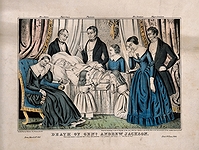
Place of death: 'The Hermitage', near Nashville
Place of burial: Nashville, Tennessee
Son of Andrew Jackson and Elizabeth Hutchinson. He married Rachel Donelson
in 1791 and 1794. He had no biological issue.


© 2024 The Universal Compendium