


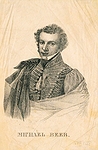
Michael Beer
(1800-33)
Biographical
Poet and playwright. At the Werder Gymnasium, Berlin, where Beer
was completing the education he had received at home, he early showed
a marked preference for the tragedians among the classical writers of
ancient Greece and Rome. At the age of eighteen he wrote his first
tragedy, 'Klytemnestra', which was produced at the Hoftheater, Berlin,
Dec. 8, 1819, and made a favourable impression. After this youthful
attempt—which revealed the weak points of his insufficient training, while
the success of the play encouraged him in the pursuit of a literary career—he
plunged with renewed fervour into his interrupted studies, following courses
in history, philology, the natural sciences, and philosophy at the universities
of Berlin and Bonn.
Beer's extensive travels through European countries contributed much to
the liberal character and thoroughness of his education. From his
second journey to Italy he brought home a new tragedy, 'Die Bräute von
Aragonien', suggested by Goethe's ballad, 'Die Braut von Korinth'.
It was published, simultaneously with 'Klytemnestra', in Leipzig in 1823.
The most successful of Beer's works was the one-act tragedy 'Der Paria'.
With remarkable stagecraft, which is lacking in his later productions,
he concentrated into a single act a story rich in content and full of
stirring incident. It was produced for the first time Dec. 22, 1823,
in Berlin, and received an ovation, Goethe himself adding warm praise
to the plaudits of the audience. The author pictures in vivid colours
the momentous struggle which a noble nature undergoes in a conflict with
the depressing influence of degrading circumstances. It is an eloquent
and bitter outcry against the oppression of the Jews in Europe.
In 1824 Beer moved to Paris, where the large circle of acquaintances and
the growing fame of his brother, Giacomo Meyerbeer, threw open the doors
of every salon to the young German poet. He soon learned to know
intimately a number of eminent litterateurs, artists, and statesmen in
Paris, and before the end of the year he felt as much at home in the French
metropolis as at his father's home in Berlin. He rarely returned
to his native city in after-days, spending the rest of his life in Paris,
on the Rhine, or in Munich, where he succumbed to neurasthenia at the
age of thirty-two.
The largest and best, if not the most successful, of Beer's works was
his 'Struensee', a tragedy in five acts, dedicated to King Ludwig of Bavaria,
and produced for the first time March 27, 1828, in Munich. It was
very favourably received; and Count de St Aulaire, with whom Beer became
intimately acquainted while in Paris, made it known to the reading public
in France by his translations of several scenes from the tragedy, which
appeared in the 'Revue Française'. The whole work, published originally
in Stuttgart, 1829, was later translated into French by Ferguson (Paris,
1834, simultaneously with a translation of 'Der Paria', by Xavier de Marmier).
A fine edition of this tragedy, with an introduction by Joseph Kürschner,
is to be found in Kürschner's 'Deutsche Nationalliteratur', cxxxvi., 1889.
Beer was also the author of some excellent poems, among which may be mentioned
his 'Elegies' written in Italy (1826). A complete edition of Beer's
works was prepared two years after his death by his friend and admirer
Eduard von Schenk, the noted Bavarian poet and statesman (Leipzig, 1835).
Moved to Paris, 1824.
Place of birth: Berlin
Place of death: Munich
 |
Sources
1. I. Singer, A. S. Chessin. Beer, Michael. The Jewish Encyclopedia, vol. 2. New York: Funk and Wagnalls Company, 1907.
Families | Lands | Abbreviations and Symbols