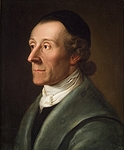
| Johann
Kaspar Lavater
(1741-1801)
Biographical
Swiss poet, pastor, and founder of physiognomics, Lavater was educated
at the gymnasium of his native town, where J. J. Bodmer and J. J. Breitinger
were among his teachers. When barely twenty-one he greatly distinguished
himself by denouncing, in conjunction with his friend, the painter H.
Fuseli, an iniquitous magistrate, who was compelled to make restitution
of his ill-gotten gains. In 1769 Lavater took orders, and officiated till
his death as deacon or pastor in various churches in his native city.
His oratorical fervour and genuine depth of conviction gave him great
personal influence; he was extensively consulted as a casuist, and was
welcomed with demonstrative enthusiasm in his numerous journeys through
Germany. His mystical writings were also widely popular. Scarcely a trace
of this influence has remained, and Lavater's name would be forgotten
but for his work on physiognomy, Physiognomische Fragmente zur Beförderung
der Menschenkenntnis und Menschenliebe (1775-1778). The fame even
of this book, which found enthusiastic admirers in France and England,
as well as in Germany, rests to a great extent upon the handsome style
of publication and the accompanying illustrations. It left, however, the
study of physiognomy, as desultory and unscientific as it found it. As
a poet, Lavater published Christliche Lieder (1776-1780) and two
epics, Jesus Messias (1780) and Joseph von Arimathia (1794),
in the style of Klopstock. More important and characteristic of the religious
temperament of Lavater's age are his introspective Aussichten in die
Ewigkeit (1768-1778); Geheimes Tagebuch von einem Beobachter seiner
selbst (1772-1773) and Pontius Pilatus, oder der Mensch in allen
Gestalten (1782-1785). From 1774 on, Goethe was intimately acquainted
with Lavater, but at a later period he became estranged from him, somewhat
abruptly accusing him of superstition and hypocrisy. Lavater had a mystic's
indifference to historical Christianity, and, although esteemed by himself
and others a champion of orthodoxy, was in fact only an antagonist of
rationalism. During the later years of his life his influence waned, and
he incurred ridicule by some exhibitions of vanity. He redeemed himself
by his patriotic conduct during the French occupation of Switzerland,
which brought about his tragic death. On the taking of Zürich by the French
in 1799, Lavater, while endeavouring to appease the soldiery, was shot
through the body by an infuriated grenadier; he died after long sufferings
borne with great fortitude.
Place of birth and death: Zurich |