Amazon
Ads |


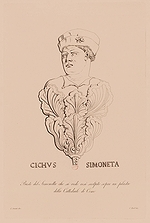
Cicco
Simonetta
Signore di Sartirana
(c. 1410–80)
Other names: Francesco,
Cicco de Gucia, Cicco da Policastro
Biographical
Signore di Sartirana 1451–80 depr.
Signore del sale nell’Oltrepò
Knight 1450 (Milan)
Ducal secretary of Milan 1450
Governor of Lodi 1449
Presidente della Regia Camera della Sommaria of Naples 1448
Highly educated, Cicco began his career as a notary, and entered the service
of Duke Francesco Sforza of Milan after 1430. In 1436 he was involved
with the Venetian-Florentine league at San Miniato, a position he owed
to the influence of his maternal uncle Angelo
whose surname he, along with his brothers Giovanni and Andrea, adopted.
Documents show that Cicco was using his paternal surname (de Gucia) up
until the 1440s.
He began to rise rapidly in the Sforza administration, and was granted
various fiefdoms in Ancona. He was present at the battle of Caravaggio
in 1448. After the Sforza conquest of Milan, Cicco was made secretary
of the ducal chancellery. Initially he resided at Cremona, obtaining citizenship
there. As with his uncle and the rest of his family, he was able to accumulate
much wealth, a number of citizenships and tax exemptions. He obtained
the castle and lands of the Lomellina district in 1451-52, and continued
to obtain numerous other properties and land throughout the Lombard domain.
He was, by now, head of the ducal secretariat, and had become a highly
respected, powerful, indispensable figure upon whom Duke Francesco was
heavily reliant, and he was viewed with contempt by certain couriers and
nobles, of which, Cicco was fully aware. His power and influence continued
under the new duke, Galeazzo, with whom he sided during the dispute with
his mother, Duchess Bianca Maria Visconti. After Galeazzo's assassination,
Cicco continued as a political leader under Duke Gian Galeazzo and his
mother, Bona Sforza, his regent, and lead a council created to deal with
the difficult internal situation, particularly, the plotting of the Sforza
brothers against the new duke, and foreign policy. Resentment against
Cicco grew after various methods employed by him to uncover plots against
the duke and the regent, and particularly after the exile of the Sforza
brothers and of Roberto Sanseverino. The number of powerful enemies against
him grew. He thwarted a number of assassination attempts and sought revenge
against those who tried to oust him. The Sforza brothers and the Sanseverino
intensified their plots and obtained significant successes during 1479.
In September that year, the rebels defeated the ducal militia, and entered
the duchy. With the consent of Duchess Bona, Cicco and his brother Giovanni
were imprisoned in the castle of Pavia and tortured. The family's assets
were confiscated and other family members forced to flee. After a trial,
Cicco was executed and his assets dispersed.
Place of birth: Policastro
or Caccuri,
Calabria
Place of death: Pavia
Place of burial: Church of Sant'Apollinare, Pavia
Son of Margherita Simonetta and Antonio de Gucia. Husband of Elisabetta
Visconti in around 1451. He had two illegitimate children by Giacomina
da Lodi, one being Guido Antonio.
 |
Sources
1. Dizionario biografico degli Italiani. Rome: Istituto della Enciclopedia italiana, 1960-2018.
2. P. Litta, L. Passerini et al. Famiglie celebri di Italia. Milan: Presso P.E. Giusti, 1819-1852.
3. B. del Bo. Cittadinanza e mestieri: radicamento urbano e integrazione nelle città bassomedievali (secc. XIII - XIV). Roma: Viella, 2014.
Families | Lands | Abbreviations and Symbols
© 2024 The Universal Compendium