| Albania
declared its independence from the Ottoman Empire in 1912,
but was conquered by Italy in 1939 and occupied by Germany
in 1943. Communist partisans took over the country in 1944.
Albania allied itself first with the USSR (until 1960), and
then with China (to 1978). In the early 1990s, Albania ended
46 years of isolated communist rule and established a multiparty
democracy. The transition has proven challenging as successive
governments have tried to deal with high unemployment, widespread
corruption, dilapidated infrastructure, powerful organized
crime networks, and combative political opponents.
Albania has made progress in its democratic development since
it first held multiparty elections in 1991, but deficiencies
remain. Most of Albania's post-communist elections were marred
by claims of electoral fraud; however, international observers
judged elections to be largely free and fair since the restoration
of political stability following the collapse of pyramid schemes
in 1997. Albania joined NATO in April 2009 and in June 2014
became an EU candidate. Albania in April 2017 received a European
Commission recommendation to open EU accession negotiations
following the passage of historic EU-mandated justice reforms
in 2016. Although Albania's economy continues to grow, it
has slowed, and the country is still one of the poorest in
Europe. A large informal economy and a weak energy and transportation
infrastructure remain obstacles.
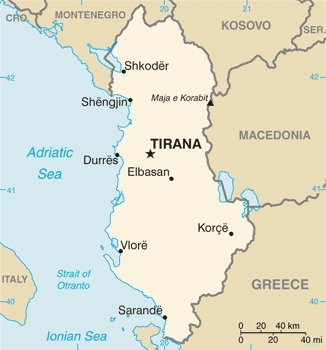
Location: Southeastern Europe, bordering the Adriatic Sea
and Ionian Sea, between Greece to the south and Montenegro
and Kosovo to the north.
|