|
In 1816, the United Provinces of the Rio Plata declared their
independence from Spain. After Bolivia, Paraguay, and Uruguay
went their separate ways, the area that remained became Argentina.
The country's population and culture were heavily shaped by
immigrants from throughout Europe, with Italy and Spain providing
the largest percentage of newcomers from 1860 to 1930. Up
until about the mid-20th century, much of Argentina's history
was dominated by periods of internal political unrest and
conflict between civilian and military factions.
After World War II, an era of Peronist populism and direct
and indirect military interference in subsequent governments
was followed by a military junta that took power in 1976.
Democracy returned in 1983 after a failed bid to seize the
Falkland Islands (Islas Malvinas) by force, and has persisted
despite numerous challenges, the most formidable of which
was a severe economic crisis in 2001-02 that led to violent
public protests and the successive resignations of several
presidents. The years 2003-15 saw Peronist rule by Néstor
and Cristina Fernández de Kirchner, whose policies
isolated Argentina and caused economic stagnation. With the
election of Mauricio Macri in November 2015, Argentina began
a period of reform and international reintegration.
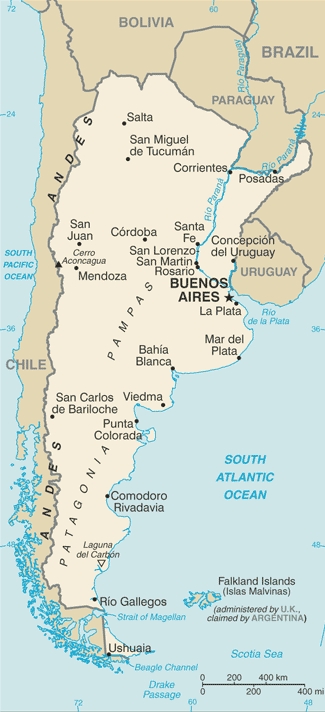
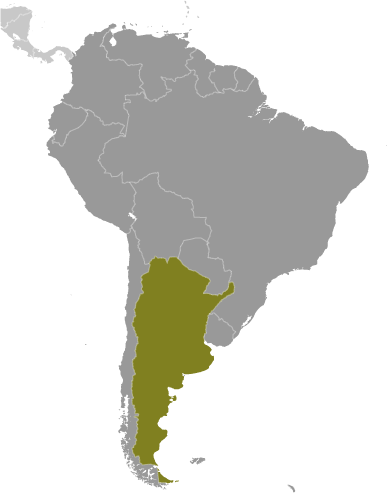
Location:
Southern South America, bordering the South Atlantic Ocean,
between Chile and Uruguay.
|