|
India has a long and complex history shaped by ancient cultures,
powerful empires, colonial rule, and its modern development
as a diverse and populous nation. Home to some of the world's
oldest urban centres, India saw the rise of influential kingdoms
and philosophical traditions, including Hinduism, Buddhism,
and Jainism, which spread across Asia. The Maurya and Gupta
empires oversaw periods of political unity and intellectual
advancement, while later regional dynasties, including the
Cholas, Rajputs, and Mughals, contributed to India's rich
artistic, architectural, and administrative heritage. European
traders arrived in the 15th century, leading to British colonial
rule, which profoundly altered India's economic and social
structures until independence was achieved in 1947 after a
long struggle. Post-independence, India adopted a democratic
system and pursued economic growth, industrialisation, and
social reforms, yet challenges such as poverty, inequality,
and political tensions have persisted alongside rapid urbanisation
and technological advancements. India's people, speaking hundreds
of languages and practising numerous religions, maintain deep-rooted
traditions while adapting to global influences, shaping a
society that blends continuity and change. Today, it is a
major player in global affairs, with a large economy, a strong
technological sector, and an active political presence, yet
it continues to navigate complex domestic and international
issues, balancing economic ambition with social and environmental
concerns.
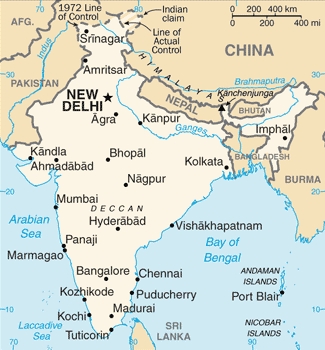
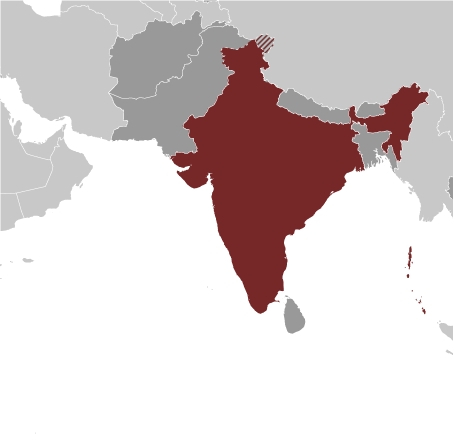
Location: Southern Asia, bordering the Arabian Sea and the
Bay of Bengal, between Burma and Pakistan.
|