Italy's story stretches across millennia. From the powerful
Roman Republic that left its mark on law and engineering to
the artistic explosion of the Renaissance, its past is interwoven
with empires, cultural advancements, and periods of division.
After centuries of fragmentation, Italy became a nation-state
in 1861 when the regional states of the peninsula, along with
Sardinia and Sicily, were united under King Victor Emmanuel
II. An era of parliamentary government came to a close in
the early 1920s when Benito Mussolini established a Fascist
dictatorship. His alliance with Nazi Germany led to Italy's
defeat in World War II. A democratic republic replaced the
monarchy in 1946 and economic revival followed. Italy is a
charter member of NATO and the European Economic Community
and its subsequent successors the EC and the EU. It has been
at the forefront of European economic and political unification,
joining the Economic and Monetary Union in 1999. Persistent
problems include sluggish economic growth, high youth and
female unemployment, organised crime, corruption, and economic
disparities between southern Italy and the more prosperous
north.
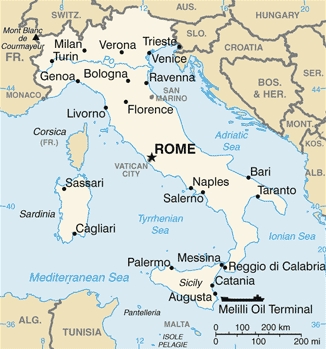
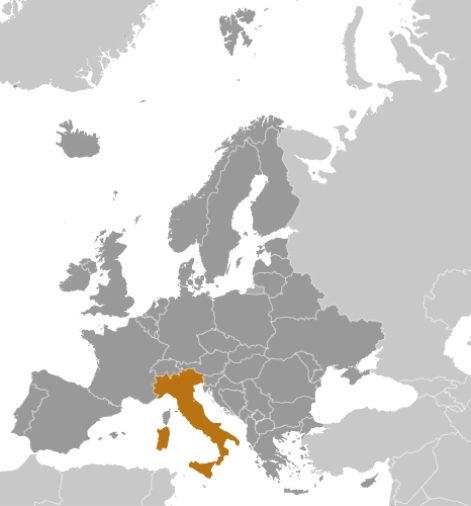
Location:
Southern Europe, a peninsula extending into the central Mediterranean
Sea, northeast of Tunisia |