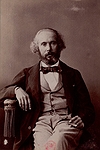
Félicien-César
David
(1810–76)
Biographical
Officer of the Legion of Honour 1862 [France]
A French Romantic composerDavid’s early life was marked by personal
loss, with his mother dying shortly after his birth and his father,
an amateur violinist, dying when he was just five. His musical potential
was recognised by Garnier, the principal oboist at the Paris Opéra,
who encouraged his development. At the age of 10, David became a chorister
at the maîtrise of St Sauveur in Aix-en-Provence, where he studied
solfège, harmony, and singing under the Abbé Michel
and Marius Roux, soon composing motets, hymns, and even a string quartet.
His education continued at the Jesuit college of St Louis in Aix,
where he encountered opéras comiques and the sacred works of
Haydn, Mozart, and Cherubini. After brief stints as assistant conductor
and lawyer’s clerk,
he became choirmaster at St Sauveur Cathedral in 1829,
where his focus was more on church music than theatre. In 1828, he
worked as assistant conductor at the Aix Theatre, where he also began
to study composition. David’s direction changed drastically
in 1831 when he joined the Saint-Simonians, a social reformist sect.
He became the brotherhood's main artistic figure, composing chants
for their ceremonies. In 1833, he embarked on a tour to preach the
Saint-Simonian gospel, which took him to Constantinople, Smyrna, Jaffa,
Jerusalem, and Egypt. He remained in Egypt for two years, composing
oriental-inspired works, but left due to a recurrence of the plague,
returning to Europe in 1835. After his return to Paris, David’s
music struggled to gain recognition, despite the publication of Mélodies
orientales, and he retreated to Igny, focusing on instrumental music,
including symphonies and string quintets. A turning point in his career
came in 1844 with the success of Le désert, a novel
symphonic ode that solidified his reputation, leading to a series
of oriental-themed works. His later compositions, such as Moïse
au Sinaï and Christophe Colomb, continued this
trend, but his 1851 opera La perle du Brésil was more
successful theatrically, and his later works such as Herculanum
and Lalla-Roukh further explored.
In 1869, David became a member of the Académie des Beaux-Arts
and succeeded Berlioz as a member of the Institute. He also became
librarian of the Conservatoire, an office he held with less enthusiasm
and commitment than his predecessor.
Place of birth: Cadenet, Vaucluse
Place of death: Saint Germain-en-Laye
Son of Charles Nicolas David and Marie Anne Françoise Arquier.