
|
|
|
|||||||||
 |
||||||||||
| ◄◄◄ | ||||||||||
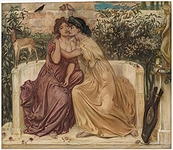
| Sappho (c. 610–c. 570 BC) Other names: Psappho Biographical A Greek poet, Sappho was one of the two chief figures of the Aeolian lyric school alongside Alcaeus and was thought to have come from Lesbos, though some sources name Mytilene. Ovid states that her father died when she was six, while Sappho speaks of her mother as being alive. Ovid’s epistle in the Heroides on her love for Phaon refers to most known events of her life. She had a daughter, Cleis, whom she mentions with affection, and three brothers named by Suidas as Charaxus, Larichus, and Eurigius. The period in which Sappho lived is established through ancient writers and references in her surviving verses. The period in which Sappho lived is known through the testimony of ancient writers, who place her activity between about 620 BC and after 570 BC. She was a contemporary and friend of Alcaeus, as shown by surviving verses in which the two poets address one another. The length of her life cannot be fixed, though references connected with her family, and those by other writers and herself, indicate that she was still active after 572 BC and did not die young. Beyond this, almost nothing is known of Sappho’s life, apart from a vague reference in the Parian Marble and in Ovid to her flight from Mytilene to Sicily between about 604 and 592 BC, to escape some unknown threat. Even so, her standing and way of life at Mytilene can be inferred, a subject of interest made necessary by long-standing distortions of the truth in both ancient and modern accounts. The story of Sappho’s love for Phaon and her leap from the Leucadian rock has no historical basis. Phaon is never named in her surviving poems and first appears in later comedy, probably borrowed from myth, though how he became linked with Sappho is unknown. Some verses referring to her love for a beautiful youth may have prompted the tale, while the leap itself is best understood as a poetic image drawn from ritual practice and is absent from her extant work. Sappho’s relations with other women have also been a subject of interest. She appears to have been the centre of a female literary circle, largely made up of pupils trained in the technical side of her art, and at Lesbos she led a major poetic school in a society where poetry was cultivated by women and men alike. Ancient writers mention her female companions and pupils, and Sappho herself refers to her household as devoted to the service of the Muses. Sappho’s poems were arranged in nine books, though the principle is unknown, and she was said to have sung them in the Mixo-Lydian mode of her own invention. Her surviving odes show complete command of verse, with close union of sense and sound, placing her among the foremost technical poets, while her treatment of passion, praised by Longinus in the ode to Anactoria, was later matched only by Catullus and the Vita Nuova. Her fragments also show a strong feeling for natural beauty, and although the ancients credited her with satirical power, they judged her hexameters inferior to those of her pupil Erinna. Place of birth: Lesbos Daughter of Simon, or according to other sources, of Eunomius, Erigyius, Ecrytus, Semus, Scamon, Etarchus, or Scamandronymus. Later sources name her mother as Cleiss. She married Cercolas or Cercylas of Andros, and had issue. |
||||||||||
| |
||||||||||
 |
||||||||||
| |
||||||||||
 |
||||||||||


