|
The Iberian Peninsula was originally home to prehistoric peoples
who were later influenced and, in some cases, conquered by
successive cultures, including the Phoenicians, Greeks, and
Romans. After the fall of the Western Roman Empire, the Visigoths
established a kingdom that lasted until 711 AD, when Muslim
forces—primarily Arabs and Berbers—began their
conquest, ushering in centuries of Islamic rule in what became
known as al-Andalus. This period ended with the Christian
Reconquista, culminating in 1492 with the capture of Granada
and the dynastic union of Ferdinand of Aragon and Isabella
of Castile, which laid the foundations of modern Spain. The
discovery of the Americas initiated an era in which Spain
became a dominant imperial power throughout the 16th and 17th
centuries, though its influence waned from the late 1600s
onwards. The 18th century brought further decline and reform,
followed by the emergence of a constitutional monarchy in
the 19th century amid wars, loss of colonies, and political
upheaval. In the 20th century, instability led to the Spanish
Civil War (1936–1939) and the rise of Francisco Franco’s
authoritarian regime. His death in 1975 marked the beginning
of Spain’s transition to democracy, formalised with
the 1978 constitution. In the decades since, Spain has faced
economic hardship, regional independence movements—particularly
in Catalonia—and ongoing debate over its place within
the European Union. Nevertheless, it remains known for a rich
cultural heritage shaped by its varied history and strong
regional identities. As of 2025, Spain continues to grapple
with economic pressures, political polarisation, and regional
tensions, while maintaining its commitment to democratic governance. |
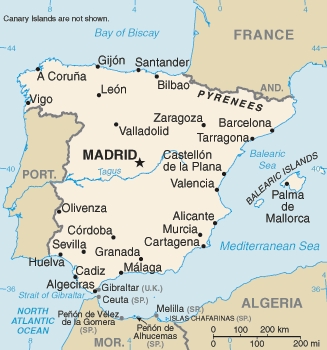
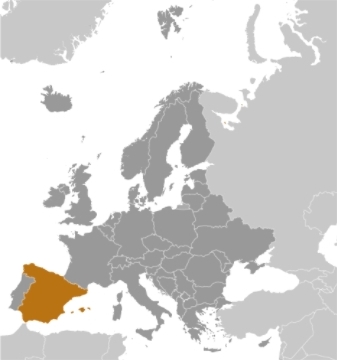
Location:
Southwestern Europe, bordering the Mediterranean Sea, North
Atlantic Ocean, Bay of Biscay, and Pyrenees Mountains; southwest
of France. |