For
over a thousand years, the popes exercised considerable secular
power, governing extensive territories across the Italian
peninsula known as the Papal States, which stretched from
central Italy to the southern regions. This arrangement began
to unravel in the 19th century with the rise of the Kingdom
of Italy, which progressively annexed various portions of
the Papal States in the lead-up to national unification. The
final blow came in 1870 when the Kingdom seized Rome itself,
effectively ending papal temporal rule. The ensuing conflict
between the Italian state and the papacy remained unresolved
until 1929, when the Lateran Treaties were concluded. These
agreements between the Holy See and the Kingdom of Italy established
Vatican City as a sovereign city-state, affirming the pope’s
spiritual authority, recognising the independence of the Vatican,
and granting Roman Catholicism a privileged status in Italy.
This status was revised in 1984 through a new concordat, which
among other provisions, removed Catholicism as the state religion,
reflecting a modern understanding of church and state relations.
Vatican City, the smallest independent state in the world,
continues to hold a significant place on the world stage,
particularly in matters of religious freedom, the protection
of persecuted Christian minorities in Africa and the Middle
East, and the concerns of refugees and migrants. The Holy
See remains engaged in international development, interreligious
dialogue, and the defence of church teaching amid rapid global
change and increasing secularisation. In recent years, the
Vatican has also focused on environmental stewardship and
the promotion of peace, as emphasised in papal encyclicals
and diplomatic efforts. At the same time, it continues to
confront ongoing challenges relating to the sexual abuse crisis
within the clergy, striving to uphold its moral teachings
while responding to the demands of a transforming world.
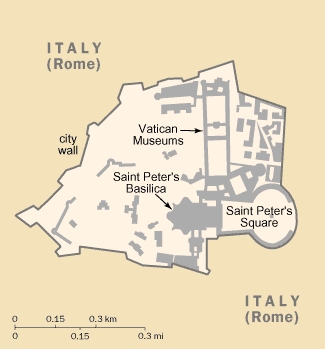
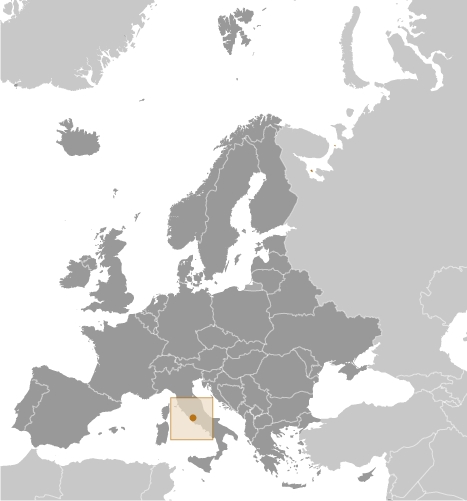
Location: Southern Europe, an enclave of Rome.
|