


Amazon
Ads |
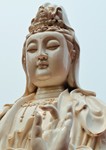


Tara
Other names: Mother of all the Buddhas and Bodhisattvas,
Queen of Heaven,
Queen of Knowledge,
Parnassavari,
Jayatara,
Sitatara
Biographical
A goddess of sailors, wisdom, and mercy,
Tara appeared among the northern Buddhist gods in the sixth century; by
the seventh, many statues of her had been erected in northern India, and
between the eighth and twelfth centuries, her popularity equalled that
of any god in the Mahayana pantheon. Many temples and colleges were dedicated
to her, and hardly a household altar was without a statue of Tara. There
are countless legends regarding the origin of Tara, one of which tells
that she was born from a blue ray shining from the eye of Amitabha. The
most widely accepted legend, however, is that a tear fell from the eye
of the god of mercy, Avalokitesvara
(her husband),
and, landing in the valley below, formed a lake. From its waters arose
a lotus flower, which, as it opened, revealed the pure goddess Tara. The
lamas believed that Tara was incarnate in all good women, and in the seventh
century, they declared the two pious wives of the Tibetan Buddhist king,
Songtsen Gampo, to be incarnations of Tara. She was then given two distinct
forms: the White Tara, believed to be incarnate in the Chinese princess
Wencheng, daughter of the emperor of China, and the Green Tara, incarnate
in the Nepalese princess Bribsun, daughter of the Newar king Amsu Varman.
The White and Green Taras thus became distinct deities. The
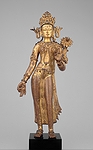
Taras are almost always depicted seated, but if they accompany Avalokitesvara
or any other important god, they are usually shown standing. She may be
surrounded by her own manifestations as well as by other gods. Sometimes,
she is depicted with seven eyes. It was said that there were twenty-one
forms of Tara.
Families | Lands | Abbr. and Symbols


© 2024 The Universal Compendium