|
|
|
|||||||||
 |
||||||||||
| ◄◄◄ | ||||||||||
| St
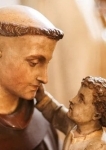
Christopher (–251?) Biographical A martyr, probably of the third century, St Christopher is one of the most popular saints in the East and the West, but almost nothing certain is known about his life or death. The legend says: a heathen king in Canaan or Arabia, through the prayers of his wife to the Blessed Virgin, had a son whom he called Offerus Offro, Adokimus, or Reprebus and dedicated to the gods Machmet and Apollo. Acquiring in time extraordinary size and strength, Offerus resolved to serve only the strongest and the bravest. He bound himself successively to a mighty king and to Satan, but he found both lacking in courage, the former dreading even the name of the devil while the latter was frightened by the sight of a cross at the roadside. For a time, his search for a new master was in vain, but at last he found a hermit Babylas who told him to offer his allegiance to Christ, instructed him in the Faith, and baptised him. Christopher, as he was now called, would not promise to do any fasting or praying, but willingly accepted the task of carrying people, for God’s sake, across a raging stream. One day, he was carrying a child who continually grew heavier, so that it seemed to him as if he had the whole world on his shoulders. The child, on inquiry, made himself known as the Creator and Redeemer of the world. To prove his statement, the child ordered Christopher to fix his staff in the ground. The next morning it had grown into a palm tree bearing fruit. The miracle converted many. This excited the rage of the king, prefect of that region, Dagnus of Samos in Lycia?. Christopher was put into prison and, after many cruel torments, beheaded. The Greek legend may belong to the sixth century; about the middle of the ninth, it is found spread through France. Originally, St Christopher was only a martyr and, as such, is recorded in the old martyrologies. The simple form of the Greek and Latin passio soon gave way to more elaborate legends. The idea conveyed in the name, at first understood in the spiritual sense of bearing Christ in the heart, was in the twelfth or thirteenth century taken in a realistic meaning and became the characteristic of the saint. The fact that he was frequently called a great martyr may have given rise to the story of his enormous size. The stream and the weight of the child may have been intended to denote the trials and struggles of a soul taking upon itself the yoke of Christ in this world. St Christopher is one of the fourteen holy helpers. He is the patron saint of Baden, Brunswick, Mecklenburg, and America, as well as of bookbinders, gardeners, sailors, bachelors, bus and lorry drivers, motorists, and porters. He is invoked against lightning, storms, epilepsy, pestilence, amongst others. Place of burial (relics): Paris and Rome |
||||||||||
| |
||||||||||
 
 
 |
||||||||||
| |
||||||||||
 |
||||||||||
|
||||||||||