|


St
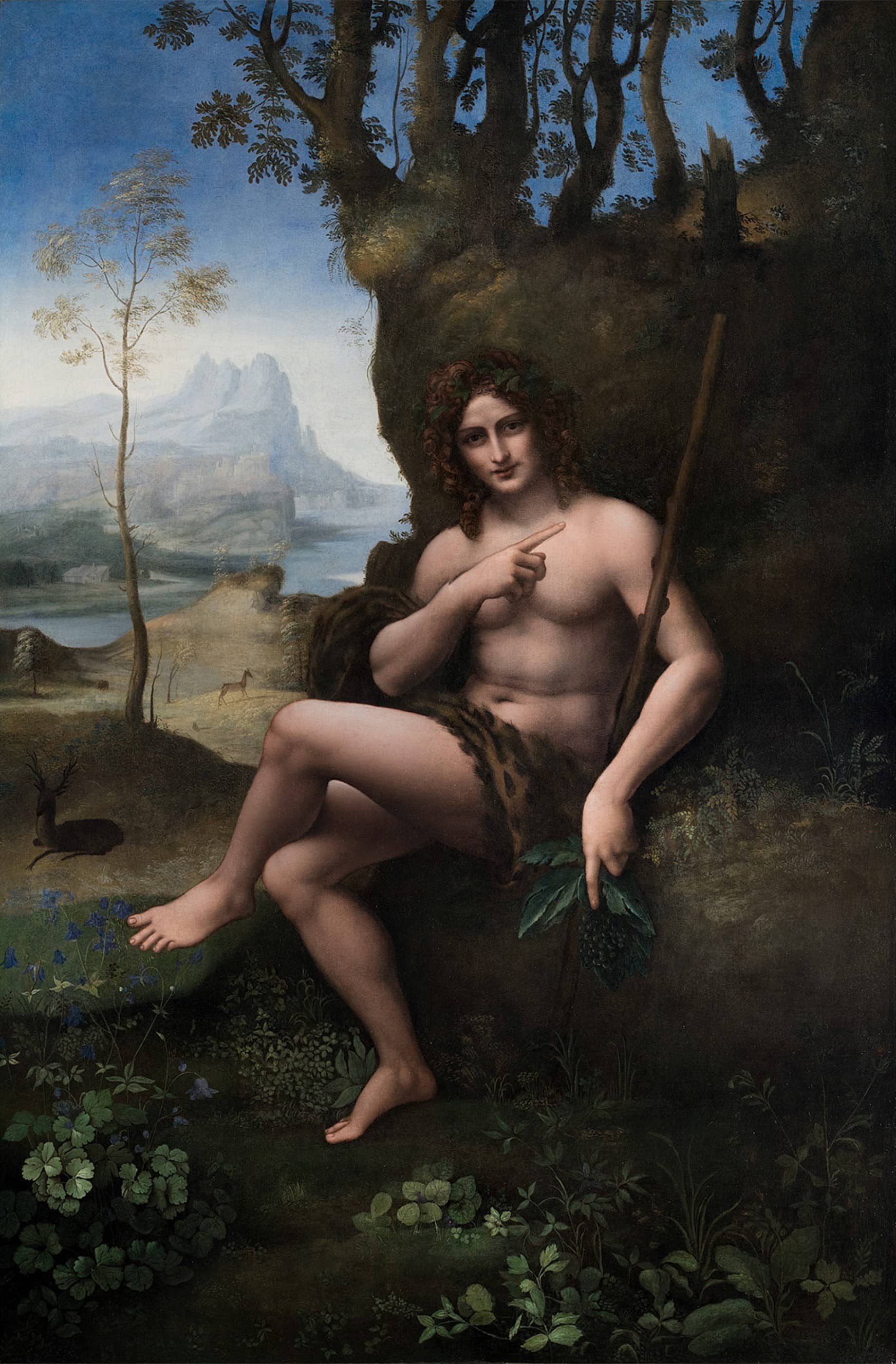
John the Baptist
Oil on panel on canvas, 177 x 201 cm, attributed to Leonardo
da Vinci, 1517–20
Musée du Louvre, Paris
In 1625, the Italian scholar Cassiano dal Pozzo described this painting
as being by the hand of da Vinci. Similar to the other painting of St
John the Baptist by da Vinci, it is now generally considered to by his
studio, perhaps by Francesco Melzi. Known as both Saint John the
Baptist and Bacchus, it presents a fascinating case of
artistic evolution and transformation. The circumstances surrounding
its creation are unknown, however, the inclusion of a landscape background
sets it apart from a similar work by da Vinci, suggesting a more narrative
intent for this particular depiction. While a red chalk drawing was
initially considered a potential preparatory sketch by da Vinci, it's
now attributed to his studio, possibly by his student Francesco Melzi.
The painting's enduring appeal is evident by the existence of numerous
versions, some reflecting the current Bacchus portrayal and others retaining
the original Saint John figure. This widespread popularity hints at
da Vinci's involvement in the initial design. Stylistic elements within
the work echo paintings by Raphael and Michelangelo, potentially influenced
by da Vinci's time in Rome during the early 16th century. Recent restoration
revealed exceptional execution throughout the work, with details like
the meadow flowers and defined musculature reminiscent of another work
by Melzi. The handling of skin tones, however, displayed a subtler approach
with more nuanced transitions between light and shadow, suggesting a
potentially later work by Melzi compared to his Berlin piece. Notably,
the painting's religious significance seems to have waned over time.
By the 17th century, the smiling figure of the saint no longer resonated
with religious sensibilities. This likely explains the dramatic transformation
undertaken in the late 17th century, where the figure was converted
into a pagan god – Bacchus. This transformation involved the addition
of various Bacchic attributes, such as grapes, an ivy crown, and the
conversion of the original cross into a thyrsus staff. The painting's
journey continued throughout the following centuries, undergoing a transfer
from wood to canvas in the late 18th century and further restorations
in the 19th century. The most recent restoration, completed between
2017 and 2019 revealed the presence of a spotted animal skin, aligning
with da Vinci's other Saint John painting in the Louvre. However, elements
such as the grapes, ivy wreath, and thyrsus were confirmed as later
additions.

|
|
|