|


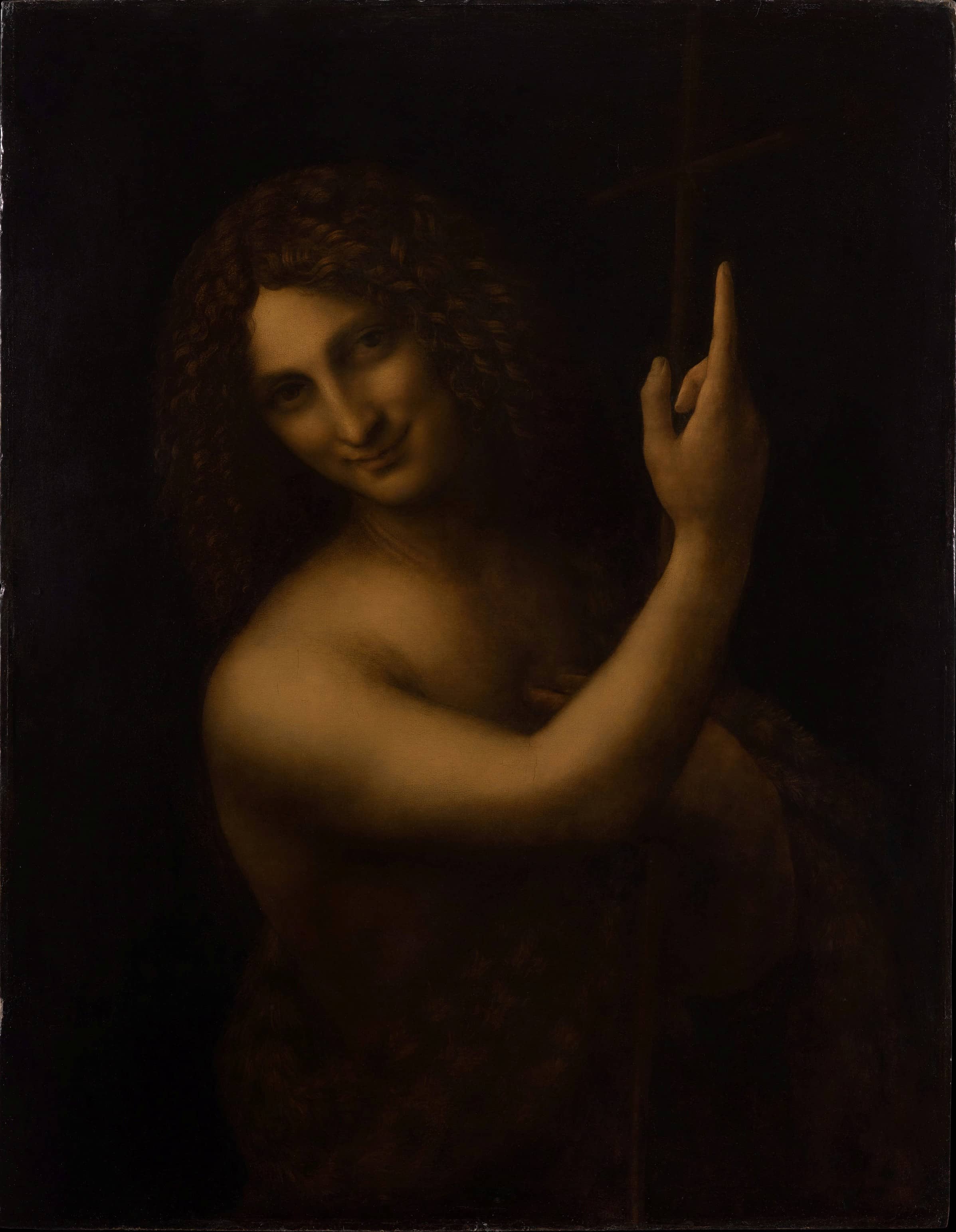
St
John the Baptist
Oil on panel, 72.9 x 56.3, by Leonardo
da Vinci, 1508–19
Musée du Louvre, Paris
Da Vinci's portrait is an unfinished work shrouded in mystery. X-ray
and other scientific examinations revealed numerous changes Leonardo
made during the creation process, including the saint's posture, arm
position, and hairstyle. These alterations are documented in numerous
copies created in Leonardo's studio, allowing researchers to trace the
painting's evolution. Scholars debate the authenticity of certain sections,
particularly the right arm, due to its awkward appearance. Recent restoration
efforts revealed these areas were simply left unfinished. The painting
is notable for its use of light and shadow, leading some to believe
it serves as a manifesto for Leonardo's artistic philosophy. The Baptist
himself is depicted as an androgynous youth with an enigmatic smile,
sparking various interpretations. Some see him as a spiritual messenger,
while others find his beauty unsettling. The animal skin he wears is
unique and has been compared to that of Bacchus. The painting's overall
message is likely one of hope, with John the Baptist serving as a light
in the darkness, announcing the arrival of Christ.
|
|
|
Provenance
 Probably
King François I of France, 1518 Probably
King François I of France, 1518
Roger
du Plessis, Duke of Liancourt, 1620s
King
Charles I of Great Britain, 1630–49
Cruso
and Terence, 1651
Everhard
Jabach, until 1622
King
Louis XIV of France, 1662
Royal
collection, until 1792
Musée
du Louvre, 1793
Source: Musée du Louvre, 2023.
|