|


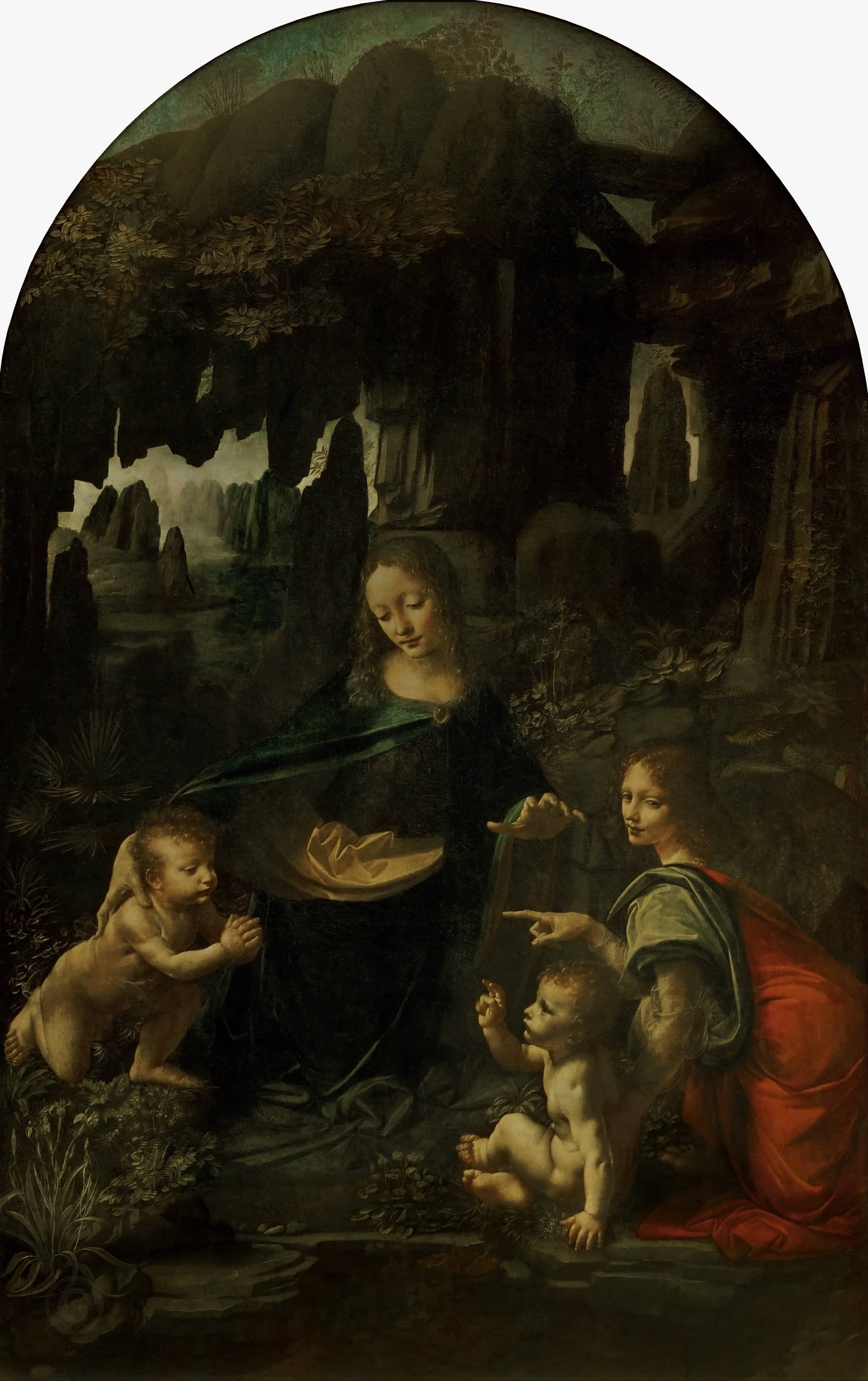
The Virgin of the Rocks
Oil on panel transferred to canvas, 199.5 x 122 cm, by
Leonardo
da Vinci,
1483–94
Musée du Louvre, Paris
This painting was first mentioned in 1625 at Château de Fontainebleau.
Its acquisition is shrouded in uncertainty, and was speculated to
have occurred between 1499 and 1512 under Louis XII or later under
François I. Originally commissioned for a chapel in Milan in 1483,
dedicated to the Immaculate Conception, the altarpiece depicted the
Virgin Mary and Child Jesus. It was intended that the altarpiece would
illustrate the concept of the Immaculate Conception, symbolically
portraying Mary protected from original sin by God amidst rocks and
mountains. However, only three surviving elements of the destroyed
altarpiece remain, now housed in the National Gallery in London. Da
Vinci's initial composition for the central panel featured the Virgin
adoring the Child Jesus, possibly with the infant Saint John the Baptist.
While the contract for the altarpiece was descriptive, da Vinci's
preparatory drawings and the final painting suggest an Adoration of
the Child Jesus, reminiscent of Florentine traditions. The theme allowed
Leonardo to explore the Incarnation, portraying divine mysteries through
a narrative dimension. The existence of two versions of the Virgin
of the Rocks has puzzled historians, with the Louvre version considered
the first, stylistically preceding the London version. Various hypotheses
had been formulated regarding their origin and purpose. It was suggested
that the two paintings were intended for different altarpieces, whilst
the majority favoured the theory of a substitution, wherein the Louvre
painting was replaced by the London one due to financial disputes
and changes in composition requested by the patrons. Infrared studies
of both versions in 2005 and 2009 made it possible to definitively
reject the theory of substitution, substantial differences between
both versions were revealed. The Louvre version, characterised by
its emotional depth and naturalistic setting, displays Leonardo's
mastery of chiaroscuro and symbolism. Its composition, cantered on
the Adoration of the Child Jesus, invites viewers to contemplate divine
mysteries through narrative elements and intricate emotional expressions.


|
|
|