
|
|
|
|||||||||
 |
||||||||||
| Jan Brueghel the Elder (1568–1625) | ||||||||||
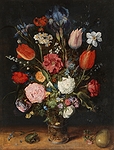
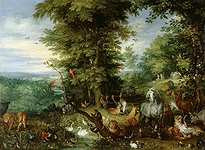
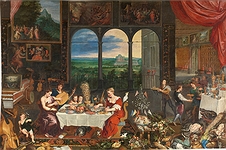
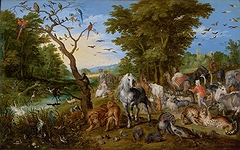
| Sometimes called 'Blumen-Brueghel,' 'Sammt-Brueghel,' or 'Fluweelen-Brueghel' ('Velvet-Brueghel')—a nickname reportedly inspired by his preference for wearing that fabric—Jan Brueghel was raised and taught distemper painting by his maternal grandmother, Marie de Bessemers, widow of Pieter Coecke van Aelst, and later learned oil painting from Pieter Goetkint. Early in his career, he gained recognition for painting flowers and fruit before turning to landscapes with small figures during a visit to Italy. While passing through Cologne, where he stayed for some time, he refined his style, and on returning to Flanders his work was highly regarded, leading him to join the Antwerp Guild in 1597. His son, Jan Brueghel the Younger, followed in his footsteps, specialising in landscapes often mistaken for his father’s. In 1601, Brueghel bought the freedom of Antwerp and became dean of the Guild the following year, and he was also a member of the 'Violet' Society. Although best known as a landscape painter, his subject paintings showed humour and careful execution. Rubens admired his work and invited him to paint landscapes for several of his easel paintings; one of their most celebrated collaborations, Adam and Eve in Paradise, features Rubens’ figures set within one of Brueghel’s finest landscapes. He also worked with Van Balen and Rottenhammer, painting small figures with such precision that he was invited to decorate churches and the landscapes of Momper. His Views of Flanders faithfully depict the region, with trees, plants, and even insects rendered in remarkable detail. In artistic skill, Brueghel surpassed his father as much as the latter exceeded his son Pieter, and alongside landscapes, he painted scenes of peasant life and demoniacal subjects, demonstrating a strong command of chiaroscuro. He died in Antwerp. | ||||||||||
| |
||||||||||

 |
||||||||||
|
|
||||||||||
| |
||||||||||
  |
||||||||||


 Art
Art