
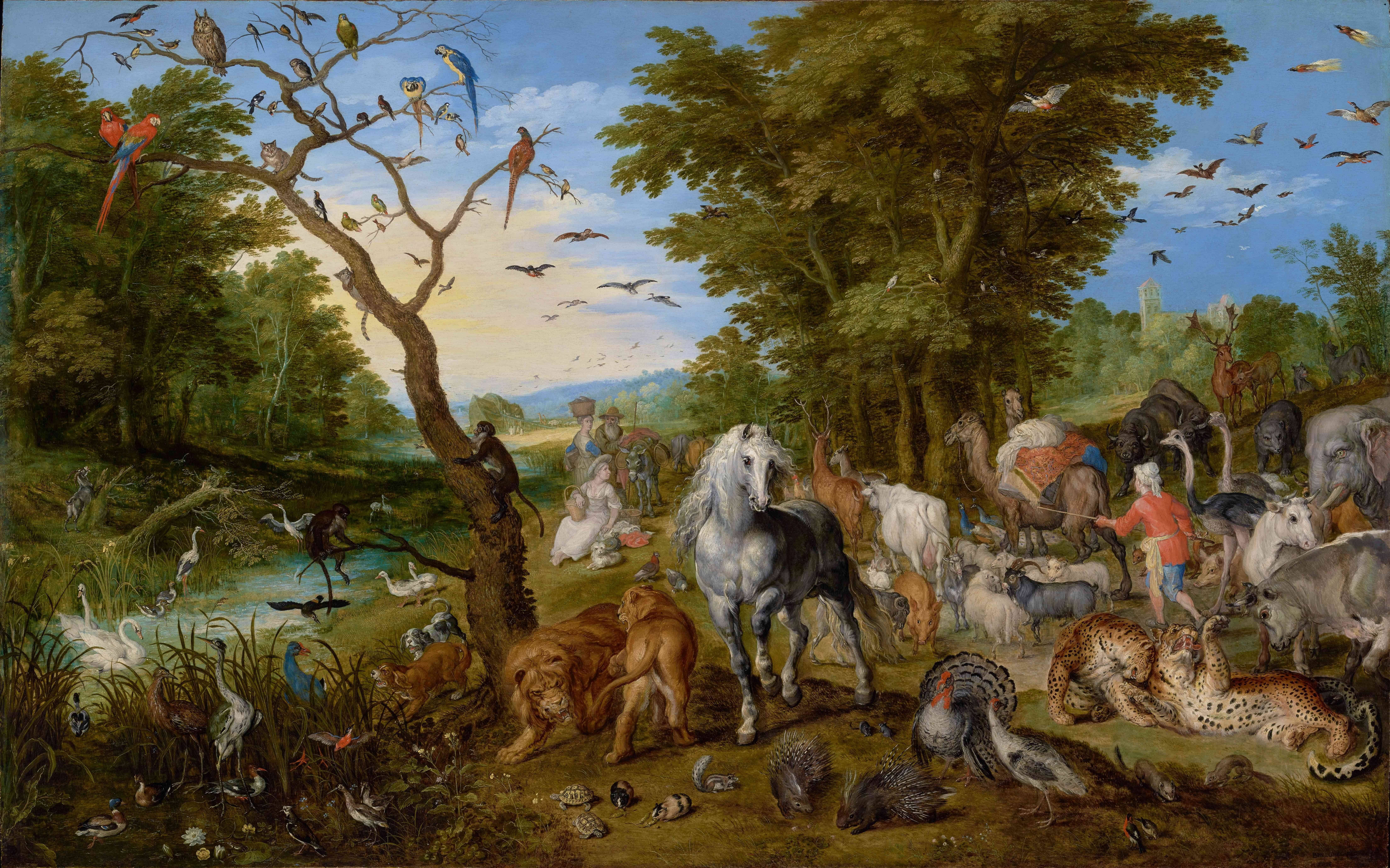
   The Entry of the Animals into Noah's Ark Oil on panel, 54.6 × 83.8 cm, by Jan Brueghel the Elder, 1613 J. Paul Getty Museum, Los Angeles Brueghel filled the composition with a vast array of animals, creating a rich and animated scene where creatures of all kinds populate the land, water, and sky. In the foreground, elephants, turtles, guinea pigs, and other animals gather, while birds and bats take flight above, leading the viewer’s gaze toward Noah, who shepherds the procession toward the distant ark. Some animals rest, while others move with energy—climbing trees, soaring through the air, or wading through the water. The variety of species depicted, from the smallest rodents to large and powerful beasts, reflects Brueghel’s attention to detail and his interest in the natural world. Painted during his tenure as court painter to Archduke Albert of Austria, Governor General of the Habsburg Netherlands, and his wife, Infanta Isabella of Spain, the work reflects the era’s fascination with nature, heightened by the exploration of the Americas and the introduction of unfamiliar species to Europe. By the late 16th and early 17th centuries, animals such as turkeys from North America and guinea pigs from South America had become familiar to European elites, appearing in collections, menageries, and artworks. The Archdukes maintained an extensive menagerie at their Brussels palace, housing exotic birds and rare creatures, which provided Brueghel with the opportunity to study them closely. His access to these living models enabled him to render the animals with striking accuracy, capturing their distinctive forms and natural behaviours with great care. Beyond demonstrating his skill in depicting the animal world, the painting reflects a broader cultural interest in cataloguing and understanding nature. At a time of growing scientific curiosity, artists such as Brueghel helped shape how people visualised and interpreted the diversity of life.   |
|


