Amazon
Ads |


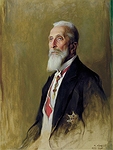
Albert
Graf Apponyi de Nagy-Appony
(1846–1933)
Biographical
Apponyi was educated at the Jesuit seminary at Kalksburg and at the universities
of Vienna and Pesth. A long foreign tour completed his curriculum, and
at Paris he made the acquaintance of Montalembert, a kindred spirit, whose
influence on the young Apponyi was permanent. He entered parliament in
1872 as a liberal Catholic, attaching himself at first to the Deák
party; but the feudal and ultramontane traditions of his family circle
profoundly modified, though they could never destroy, his popular ideals.
On the break-up of the Deák party, he attached himself to the conservative
group which followed Baron Pál Senynyey, and which opposed the
Austro-Hungarian Compromise that had given Hungary a limited degree of
autonomy within the Habsburg Empire. He eventually became its leader.
Until 1905, Count Albert was constantly in opposition, but in May of that
year he consented to take office in the second Wekerle ministry. In
1906, he was appointed Minister of Education in a coalition government.
He used his position to introduce reforms that favoured Hungarian culture
and language, at the expense of the other nationalities living in Hungary.
This caused resentment among non-Hungarians, who accused Apponyi of trying
to Magyarise them. After the breakdown of the coalition government, he
returned to the opposition and became leader of the Independence Party.
He was again appointed Minister of Education in 1917, but resigned the
following year after Hungary lost World War I. After the war, Apponyi
represented Hungary at the Paris Peace Conference and the League of Nations.
He died while serving as Hungary's delegate to the Disarmament Conference.
Apponyi was a lofty and magnetic orator, and also a prolific writer, publishing
several books on Hungarian politics and history.
Place of birth: Vienna
Place of death: Geneva
Son of György Apponyi de Nagy-Appony, and Countess Julia Sztáray.
Families | Lands | Abbreviations and Symbols
© 2024 The Universal Compendium