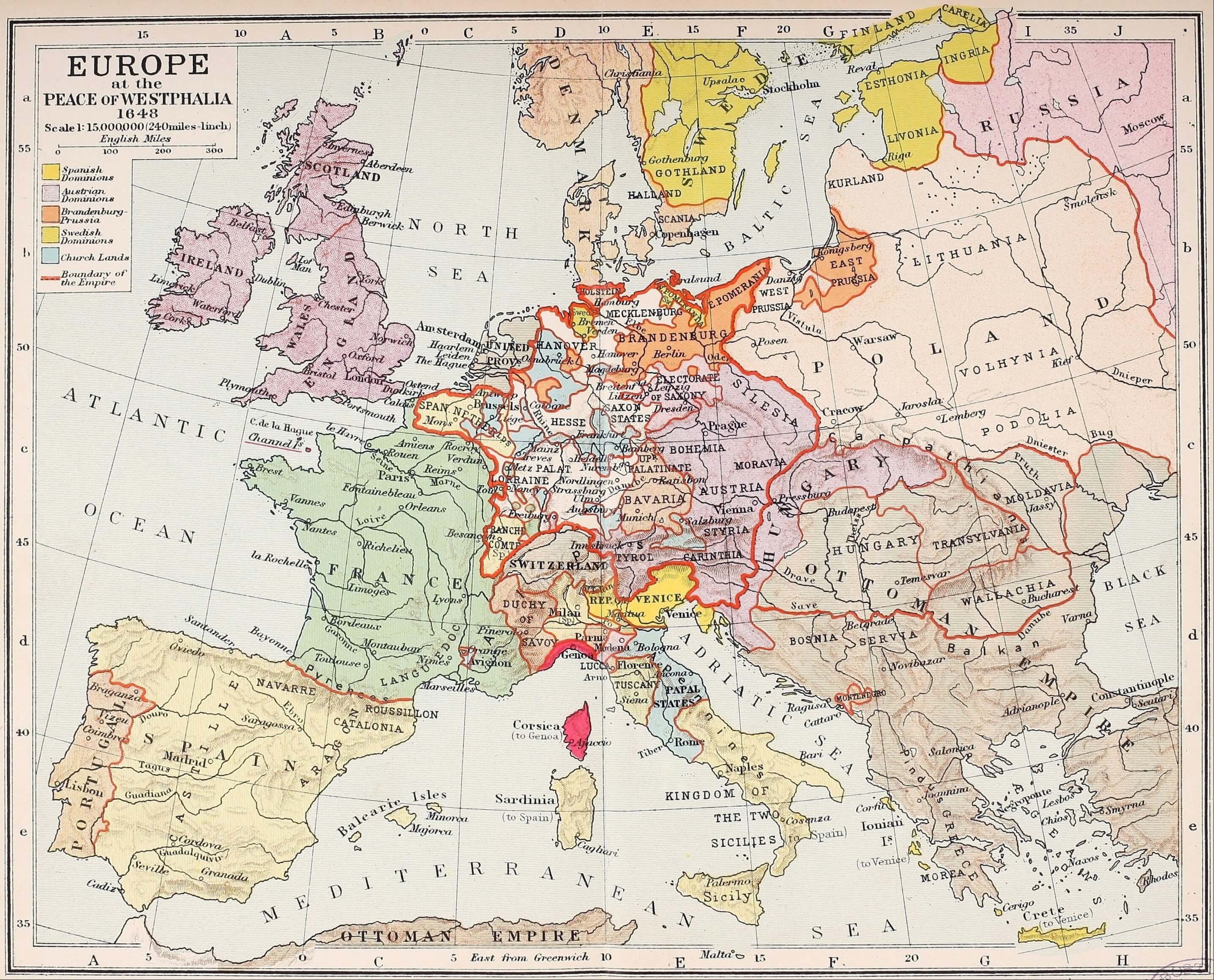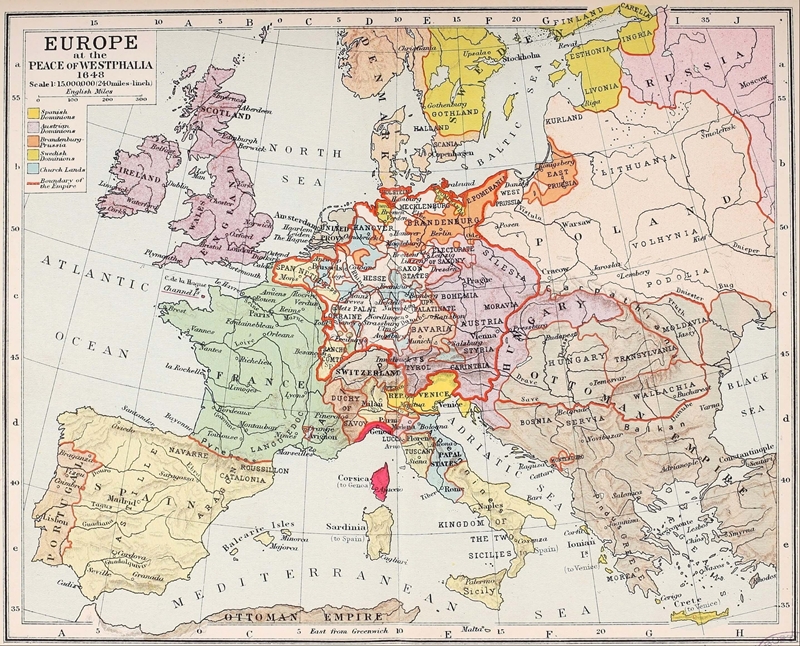
Boundary of the Holy
Roman Empire, 1648
George Philip & Son, Ltd
Map of Europe depicting the political boundaries at the time of the
Peace of Westphalia, signed in 1648, which marked the end of the Thirty
Years' War in the Holy Roman Empire and the Eighty Years' War between
Spain and the Dutch Republic. It reshaped the balance of power in
Europe by recognising the sovereignty of numerous German states, weakening
the influence of the Holy Roman Emperor. The empire is shown as a
patchwork of independent states, principalities, and bishoprics, each
with its own governance, reflecting the treaties' recognition of their
sovereignty. France expanded its eastern borders, gaining control
over Alsace, while Sweden secured territories in northern Germany,
including parts of Pomerania. The Dutch Republic and Switzerland are
marked as independent, no longer under Habsburg control. Spain, despite
maintaining its presence in Italy, had to concede the independence
of the Dutch Republic, marking the decline of its dominance in Europe.
The map also shows the Polish-Lithuanian Commonwealth, the expanding
influence of Russia, and the Ottoman Empire's presence in southeastern
Europe, reflecting the broader geopolitical shifts of the period.
The treaties established a new diplomatic framework based on state
sovereignty and non-interference, laying the groundwork for the modern
nation-state system. Religious tensions were addressed by reaffirming
the principles of the Peace of Augsburg, allowing rulers to determine
their states' official faiths.